Visit Piazzale Michelangelo and Basilica di San Miniato al Monte
This walk explores two of the Oltrarno’s most iconic highlights. First, we ascend to Piazzale Michelangelo, where sweeping views stretch across Florence’s rooftops, domes, and the winding Arno below. From there, we continue upward to the Basilica di San Miniato al Monte, one of the city’s oldest and most beautiful churches, perched high above the city and offering a peaceful, contemplative atmosphere.

Note: The full extended walk is approximately 5 miles (8 km) and can be reduced with a bus ride between San Miniato and Porta Romana
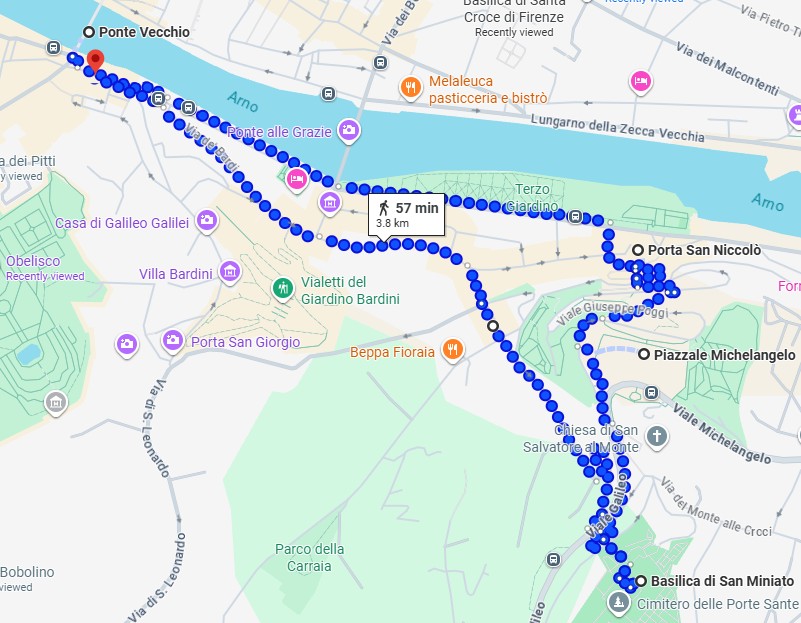
This walk offers the option to return directly to Central Florence or continue walking by descending through gardens and terraces to Porta Romana where you can explore Boboli Gardens and Pitti Palace. The walk ends in Piazza Santo Spirito, completing a journey from hillside serenity to Renaissance elegance.
How to navigate with your mobile device
JCVWalks are designed to be easy to follow on your mobile device. As you walk, you can tap the header or photo for each point of interest to open the location directly in Google Maps. This will help you navigate from your current location to the next point of interest. If you’d like to learn more about any stop along the way, just click the links in the description for additional details and context.
Porta San Niccolò
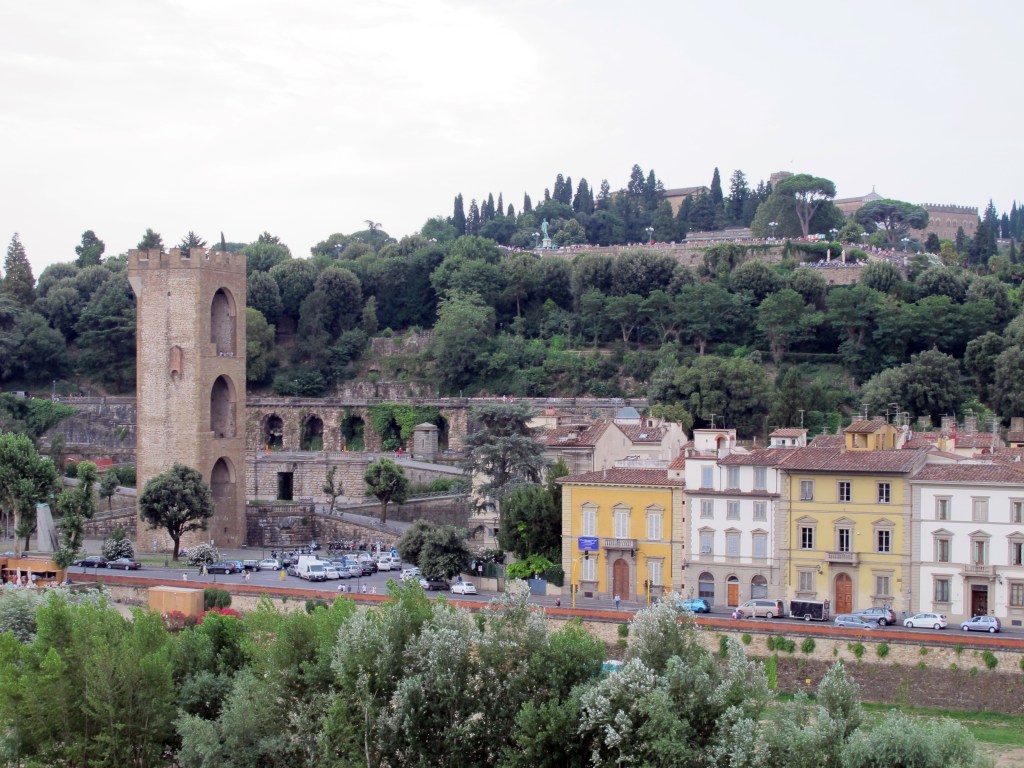
From the Ponte Vecchio, walk east along the Arno through the Oltrarno district, following Via de’ Bardi and then Via di San Niccolò until you reach Piazza Giuseppe Poggi. Here stands the imposing Porta San Niccolò, a 14th-century city gate built in 1324 as part of Florence’s medieval walls. Unlike other gates, it was never shortened, so its full height remains—a striking reminder of the city’s fortified past. From this point, the Rampe del Poggi—a series of stone staircases and zigzagging paths—lead uphill toward Piazzale Michelangelo and eventually San Miniato al Monte, offering panoramic views of Florence along the way. The climb is steep but rewarding, with several terraces perfect for catching your breath and taking photos.
Giardino delle Rose
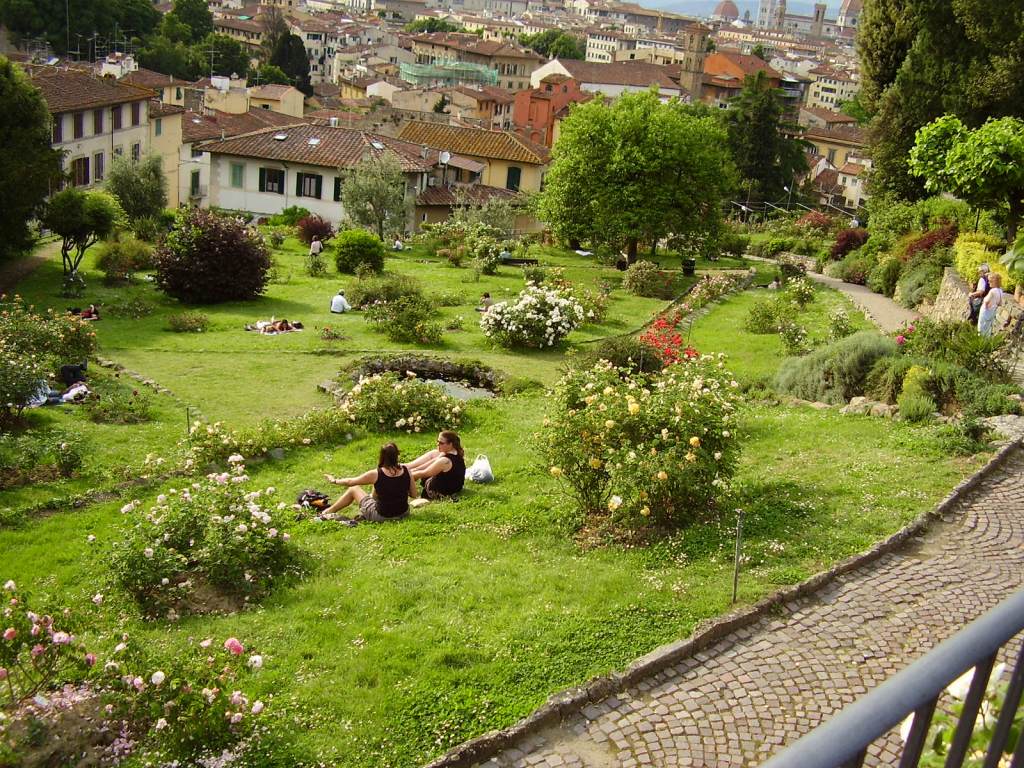
Nestled on the slopes below Piazzale Michelangelo, the Giardino delle Rose is a peaceful hillside garden created in 1865 by architect Giuseppe Poggi during Florence’s urban renewal. It features over 350 varieties of roses, lemon trees, and whimsical bronze sculptures by Belgian artist Jean-Michel Folon, making it a delightful blend of art and nature. Benches and shaded paths invite you to linger, especially in spring when the roses are in full bloom. It’s a peaceful escape from the city streets and a perfect pause before continuing uphill to Piazzale Michelangelo and the Basilica of San Miniato al Monte.
Piazzale Michelangelo
Perched high above Florence, Piazzale Michelangelo is the city’s most famous panoramic terrace, offering sweeping views of the Arno River, the Duomo, and the Tuscan hills beyond. Designed in 1869 by architect Giuseppe Poggi as part of Florence’s urban renewal, the square was intended as a tribute to Michelangelo Buonarroti. At its center stands a monumental bronze replica of Michelangelo’s David, accompanied by copies of his other masterpieces. Originally, Poggi envisioned a museum dedicated to the artist here, but the plan never materialized. Today, the piazzale is a beloved gathering spot for sunset watchers, photographers, and street performers. Accessible by foot, car, or bus, it’s a must-see for anyone seeking the quintessential Florence view. From here, paths lead further uphill to San Miniato al Monte or down to the Giardino delle Rose, making it a perfect stop on any Oltrarno walk.


San Miniato al Monte
After catching your breath at Piazzale Michelangelo, with its sweeping views and bronze replica of Michelangelo’s David, continue uphill along Viale Galileo (part of the Viale dei Colli). This route follows a grand 19th-century promenade designed by architect Giuseppe Poggi during Florence’s urban renewal when the city briefly served as Italy’s capital. Poggi envisioned these tree-lined avenues and terraces as a way to showcase Florence’s beauty, and they remain among the city’s most scenic walks.
A short climb brings you to a striking double staircase, an elegant feature of Poggi’s design, which leads to San Miniato al Monte—one of Florence’s oldest and most beautiful churches, dating back to the early 11th century. The ascent is steeper than the main promenade but rewards you with ever-expanding views of the Duomo and the Arno valley. Allow 35–40 minutes, including time for photo stops and enjoying the vistas.

Return to Ponte Vecchio
If you’ve seen what you came for at San Miniato al Monte, you can return to Florence on foot by descending the basilica’s staircase and walking down to Piazzale Michelangelo. From there, follow Viale Michelangelo downhill toward the Arno River, then turn left along Lungarno Torrigiani to reach Ponte Vecchio and the historic center. This scenic route is about 1 mile (20–25 minutes), mostly downhill with some cobblestones.
Take a Bus to Porto Romana
If you want to take the bus, walk back down the steps from Piazza San Miniato to Viale Galileo, where you’ll find the “Galileo San Miniato” bus stop just across the street. From here, catch Bus 12 (Autolinee Toscane) heading downhill toward Porta Romana. The bus winds through the quiet, leafy hills of the Oltrarno along Viale Galileo and Viale Machiavelli. Buses run every 20–30 minutes, and the ride takes about 16–20 minutes. The fare is €1.50, valid for 90 minutes, and you can pay by tapping a contactless card or mobile wallet on board. The bus drops you near the Boboli Gardens’ southern entrance, close to Palazzo Pitti and Piazza Santo Spirito.
Continue Walking to Porta Romana
For those who want to continue walking, a scenic downhill route leads to Porta Romana in about 30–35 minutes. Start by descending down the steps from the church to Viale Galileo as it curves into Viale Machiavelli, part of the historic Viale dei Colli promenade. The walk covers roughly 1.5 miles (2.5 km) mostly downhill, passing elegant hillside villas, shaded sidewalks, and panoramic viewpoints over Florence. It’s a peaceful and rewarding way to descend into the Oltrarno, ending near the southern entrance to the Boboli Gardens and the Pitti Palace.
If you have decided to walk, select the navigation points below to help keep you on the right path.
Statua Daniele Manin
As Viale Galileo curves into Viale Machiavelli, you enter one of Florence’s most elegant promenades. Part of the historic Viale dei Colli, this shaded boulevard winds gently downhill past stately villas, wrought-iron gates, and terraced gardens. Along the way, you’ll pass the Statua Daniele Manin, a striking monument to the Venetian patriot who resisted Austrian rule in the 19th century. Designed to showcase Florence’s hillside beauty, the route offers occasional panoramic views and a quiet, residential atmosphere—a scenic transition from the heights of San Miniato al Monte to the heart of the Oltrarno.


Porta Romana
This imposing stone gate marks the southern entrance to Florence’s historic center. Built in the 14th century as part of the city’s defensive walls, Porta Romana once welcomed travelers arriving from Siena and the Tuscan countryside. Today, it stands at the edge of the Boboli Gardens and the Pitti Palace, offering a natural endpoint to your descent. Nearby cafés and piazzas make it a perfect spot to pause, reflect, and enjoy a well-earned spritz or gelato.
Pitti Palace (Palazzo Pitti)
Once the grand residence of the Medici family, the Pitti Palace is a symbol of Florence’s wealth and power during the Renaissance. Built in 1458 for banker Luca Pitti, it was later expanded by the Medici into a sprawling complex that became the seat of the Grand Dukes of Tuscany. Today, it houses several world-class museums, including the Palatine Gallery, with masterpieces by Raphael and Titian, and the Treasury of the Grand Dukes. Behind the palace stretch the Boboli Gardens, a vast open-air museum of sculptures, fountains, and manicured lawns that inspired garden design across Europe.


Boboli Gardens
Enter the Boboli Gardens through the gate behind Pitti Palace and begin a peaceful uphill stroll through one of Italy’s finest examples of formal landscape design. The walk begins at the Amphitheater and the Fountain of Neptune, then continues along the Viottolone, a statue-lined avenue leading to the Isolotto and its Fountain of the Ocean. Nearby, the Garden of the Cavaliere offers a quiet retreat with rose beds and sweeping views over Florence. As we ascend, we reach the Porcelain Museum near Forte di Belvedere, which can be admired from the upper terrace. Other highlights include the Grotta del Buontalenti, a fantastical cave adorned with sculptures and frescoes, and the Kaffeehaus, an 18th-century pavilion with Rococo flair that once served as a refreshment stop for the nobility. The shaded paths offer occasional rooftop views and a tranquil escape from the city below.
Piazza Santo Spirito
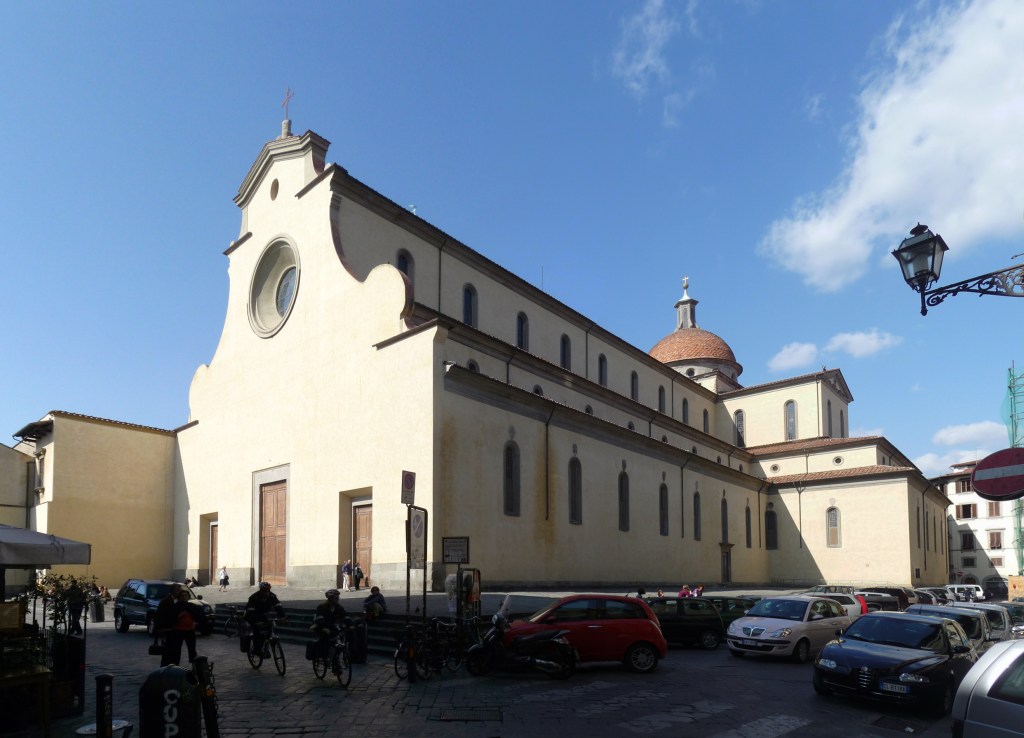
After exploring the Boboli Gardens and Palazzo Pitti, continue to Piazza Santo Spirito, a quiet square that marks the transition from palatial grandeur to neighborhood charm. From here, meander through the artisan streets of the Oltrarno—Via Maggio, known for antique shops and elegant galleries, and Via Santo Spirito and Borgo San Jacopo, where leatherworkers, woodcarvers, and contemporary designers keep centuries-old crafts alive. These lively lanes lead you gently back to Ponte Vecchio, offering a final glimpse of Florence’s handcrafted spirit before crossing the river once more.

Ponte Vecchio
We will end our walk where it began, at Florence’s most iconic bridge, the Ponte Vecchio, which reconnects us with the historic heart of the city. As we cross back over the Arno, the artisan spirit and quiet charm of the Oltrarno give way to the energy and elegance of central Florence. It’s a fitting finale: a short span that links two distinct worlds, each with its own rhythm, beauty, and story.
Thanks for walking with me!
I hope you enjoyed this exploration of this more relaxed side of Florence—where artisans still work in tucked-away studios, locals gather in leafy piazzas, and history lives in hills, gardens and streets beyond the Arno.
If you enjoyed the route, found a hidden gem, or have ideas for improving the experience, I’d love to hear from you! Your insights help me improve future walks and inspire fellow travelers. Please rate this walk using the stars below — and feel free to leave a comment. Thank you! — and happy exploring!


Click here for more JCV Walks in Florence
Your journey doesn’t have to end here. Choose another walk and let’s keep exploring together—one step at a time.
JCV Walks in Florence – Duomo
Walk in central Florence Brunelleschi’s dome to the Uffizi, exploring Florence’s most iconic landmarks and learning how the city became the cradle of the Renaissance.
JCV Walks in Florence – David
Explore Michelangelo’s David and the city he helped shape—through markets, museums, and courtyards that reveal Florence’s artistic, civic, and everyday life.
JCV Walks in Pisa
A one hour train ride from Florence, Pisa is more thanits famous leaning tower. Explore Pisa’s lively squares, arcaded shopping streets, and hidden gems
Photo Credits
- Palazzo Pitti Garden Side – Photo by Stefan Bauer, licensed under CC BY-SA 2.5, source
- Oltrarno Sunset – By Fitzws – Licensed under CC BY-SA 4.0, Source
- Porta Romana – By Rufus46 – Licensed under CC BY-SA 3.0, Source
- Basilica Santo Spirito – By Lucarelli – Own work, CC BY-SA 3.0, Source
- Palazzo Pitti Front – Photo by Almaak, licensed under CC BY-SA 3.0, source
- Boboli Gardens – By Nemo bis – Licensed under, CC BY-SA 3.0, Source
- Statua Daniele Manin – By Sailko – Licensed under, CC BY-SA 3.0, Source
- Autolinee Toscane Bus 12 – By User:Mattes – Licensed under Public Domain, Source
- Basilica di San Miniato al Monte – By Benjamín Núñez González – Licensed under CC BY-SA 4.0, Source
- Piazzale Michelangelo – By Michael Wittwer – Licensed under CC BY-SA 4.0, Source
- Giardino delle Rose – By Sailko – Licensed under, CC BY-SA 3.0, Source
- Porta San Niccolò – By Sailko – Licensed under, CC BY-SA 3.0, Source
