Exploring Towers, Scenic Vistas, and Award-Winning Gelato
San Gimignano, often called the “Town of Fine Towers,” is one of Tuscany’s best-preserved medieval hill towns. Its skyline, marked by soaring stone towers, reflects the wealth and rivalry of merchant families during the 13th and 14th centuries. Located along the Via Francigena, a major pilgrimage route to Rome, the town prospered as a trading hub for saffron and Vernaccia wine. At its peak, San Gimignano had more than 70 towers—symbols of power and status—though only 14 remain today. The historic center is a UNESCO World Heritage Site, celebrated for its intact medieval architecture, fresco-filled churches, and panoramic views of the surrounding countryside. Walking through its narrow streets offers a glimpse into a world that has changed little over the centuries, making San Gimignano a must-see destination for history, art, and culture lovers.
This walk explores San Gimignano’s medieval streets, towers, and squares, with stops at historic churches, scenic viewpoints, local favorites, and, wht some describe as the world’s best gelato.

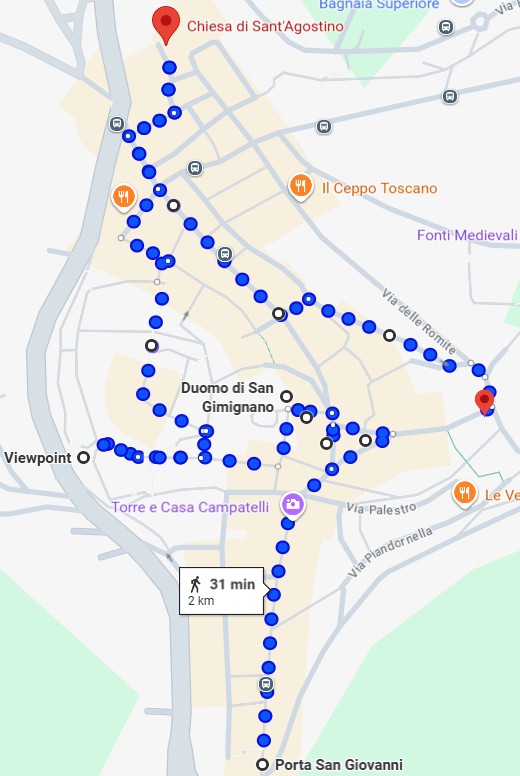
How to navigate with your mobile device
JCVWalks are designed to be easy to follow on your mobile device. As you walk, you can tap the header or photo for each point of interest to open the location directly in Google Maps. This will help you navigate from your current location to the next point of interest. If you’d like to learn more about any stop along the way, just click the links in the description for additional details and context.
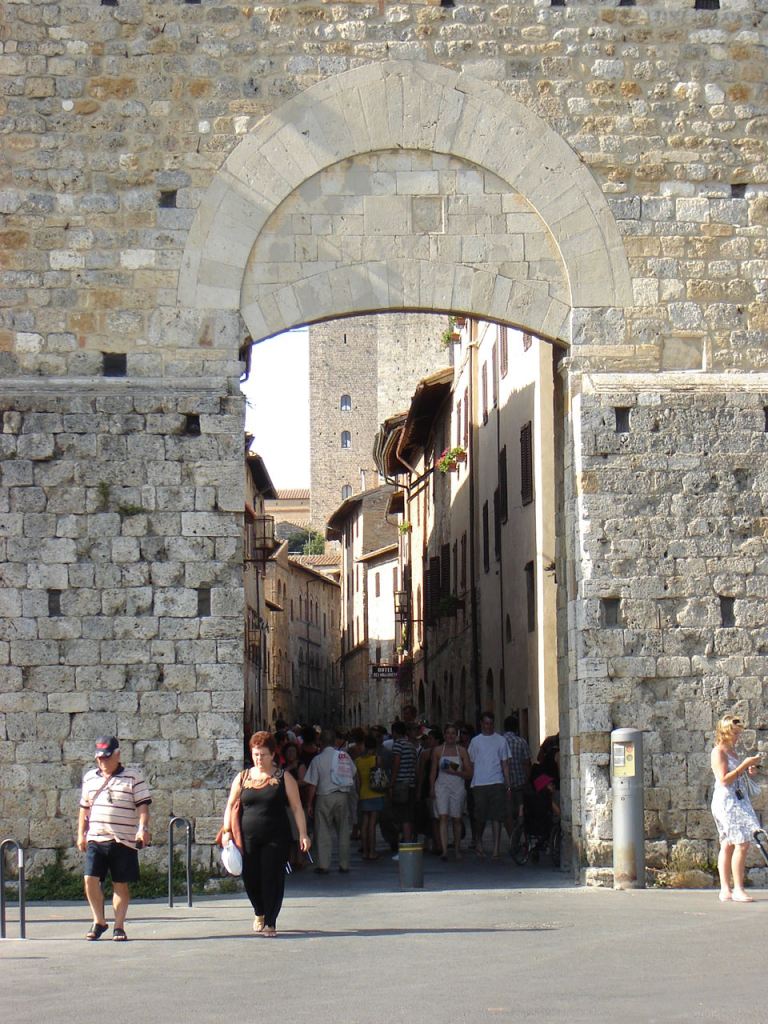
Porta San Giovanni
We’ll start our walk at Porta San Giovanni, the main southern gate into San Gimignano. Built in the 13th century, this stone gateway was part of the town’s defensive walls and controlled access for merchants and pilgrims traveling along the Via Francigena. Passing through the arch, you can still see the heavy stonework and imagine the wooden doors that once secured the town at night. Before moving on, take a quick look back—the view of the Tuscan countryside framed by the arch is worth a photo.
Via San Giovanni
From the gate, we follow Via San Giovanni, the town’s main street leading toward the historic center. This lively stretch is lined with artisan shops, wine boutiques, and cafés, making it a good place to browse for local products like saffron, Vernaccia di San Gimignano wine, and hand-painted ceramics. The street’s architecture reflects the town’s medieval prosperity, with stone façades and arched doorways that once belonged to wealthy merchant families. It’s also a convenient spot to grab a coffee or snack before continuing.

Piazza della Cisterna
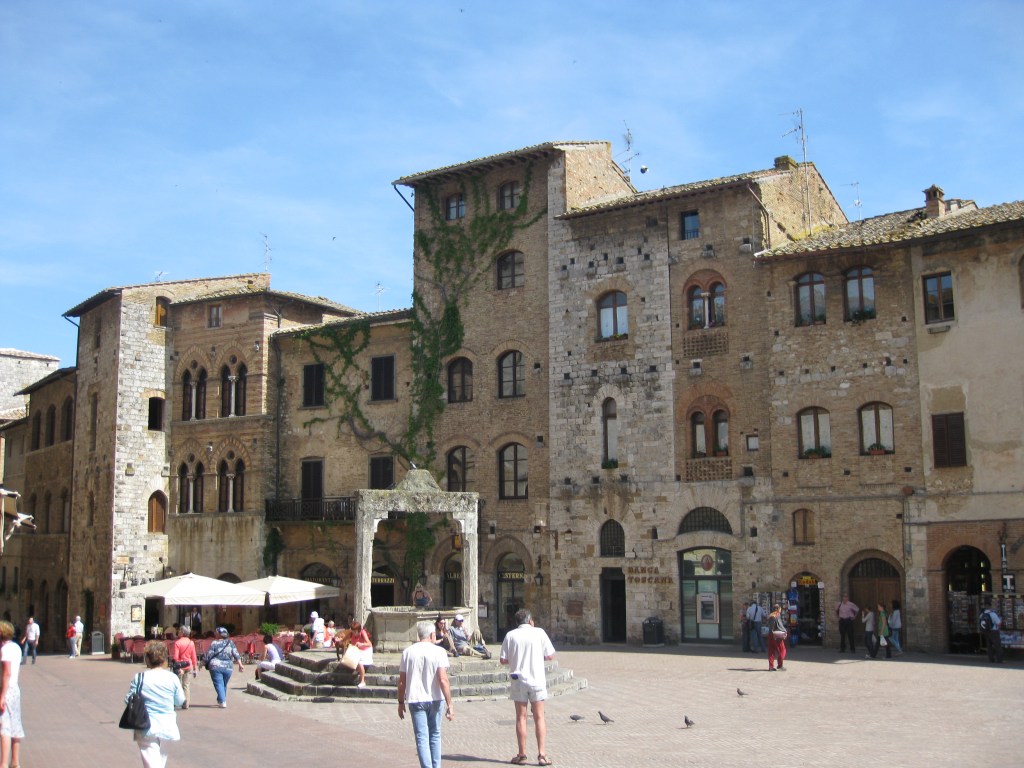
Next, we arrive at Piazza della Cisterna, one of San Gimignano’s most distinctive squares. Its triangular shape and central well date back to the 13th century, when the piazza served as a hub for markets and public gatherings. Surrounded by medieval towers and elegant palazzi, it remains a focal point for visitors today. The square is also home to several well-known gelaterias, making it a popular stop for a break. From here, you can see why San Gimignano is called the “town of towers”—many of the originals still dominate the skyline.
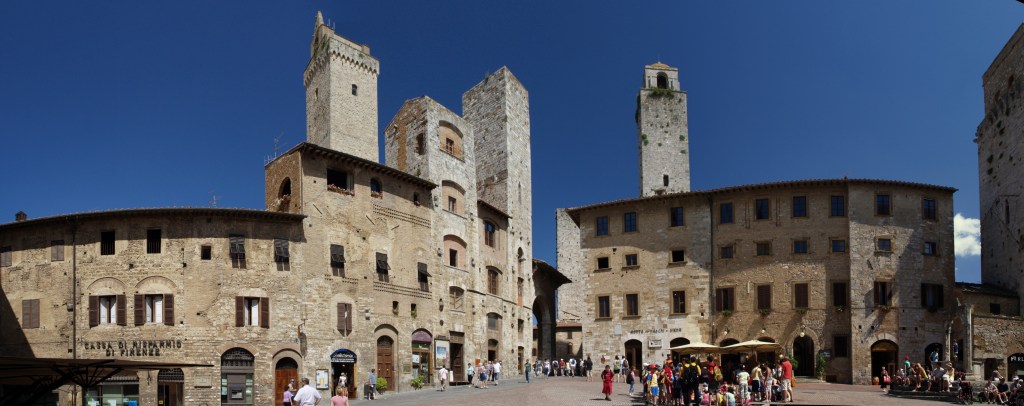

Gelateria Dondoli
Just off Piazza della Cisterna, we stop at Gelateria Dondoli, one of the most famous gelato shops in the world. Owner Sergio Dondoli has won multiple awards for his creative flavors, which range from classics like pistachio to unique combinations such as saffron with pine nuts. The shop often has a line, but it moves quickly and is worth the wait. If you’re unsure what to try, ask for a recommendation—seasonal flavors are always a good choice. Enjoy your gelato as we continue toward the next square.
Piazza del Duomo
From here, we make our way to Piazza del Duomo, a quieter square that serves as the religious and civic heart of San Gimignano. The piazza is framed by important buildings, including the Collegiata di Santa Maria Assunta (the Duomo), Palazzo Comunale, and several medieval towers such as Torre Chigi. This is a good place to pause and take in the contrast between the town’s civic and religious architecture. If time allows, we’ll step inside the Duomo next to see its remarkable frescoes.


Duomo di San Gimignano
Our next stop is the Collegiata di Santa Maria Assunta, the Romanesque cathedral of San Gimignano. Built in the 12th century, it is best known for its vivid fresco cycles by artists such as Domenico Ghirlandaio and Benozzo Gozzoli, which cover the walls with scenes from the Old and New Testaments. The interior is simple in structure but rich in color and storytelling. Admission is about €5, and photography is usually allowed without flash. If you enjoy Renaissance art, this is a highlight of the town.
Palazzo Comunale & Torre Grossa
Next, we visit the Palazzo Comunale, the historic town hall, and climb Torre Grossa, the tallest tower in San Gimignano at 177 feet. Built in the late 13th century, the palazzo houses a small civic museum with frescoes and period furnishings. The real draw, however, is the tower climb—on a clear day, the panoramic views of the Tuscan countryside are unforgettable. Admission is about €9 and includes access to the museum and tower. Don’t miss the Loggia del Comune, an open arcade at the base of the building that once hosted public meetings.


Viewpoint (Via Casale Agabito)
From the piazza, we take a short detour to a viewpoint along Via Casale Agabito. This spot offers one of the best views of the rolling hills and vineyards that surround San Gimignano. It’s a great place for photos, especially in the late afternoon when the light softens over the countryside. After enjoying the view, we’ll continue toward the remains of the old fortress.
Parco della Rocca
Backtrack a bit and walk into the Parco della Rocca, a peaceful park built on the site of a 14th-century Montestaffoli Fortress. The original structure was largely dismantled in the 16th century, but the elevated position remains, offering sweeping views of the surrounding hills and olive groves. Today, the park is a quiet place to rest, with benches shaded by trees and occasional art installations. It’s a good spot to take a break before we head to our next church. We can walk through here to our next destination.


Church of Sant’Agostino
Next, we visit the Church of Sant’Agostino, a modest brick church consecrated in 1298 that houses an exceptional fresco cycle by Benozzo Gozzoli, depicting the life of Saint Augustine. Built in the 13th century, the church also contains a beautiful marble altar and several Renaissance paintings. Admission is free, and the interior is usually quiet, making it a nice contrast to the busier squares. Take a few minutes to appreciate the detail in Gozzoli’s work before we continue and be sure to checkout the court yard.
Chiesa di San Lorenzo in Ponte
Head south along Via San Matteo, one of San Gimignano’s most authentic streets. This quieter route is lined with stone houses, small artisan shops, and glimpses of daily life that feel far removed from the busier main street. As we continue, watch for Via Capassi on your left—this is where you’ll find public restrooms, a convenient stop before our final church visit. Just ahead is the Chiesa di San Lorenzo in Ponte, a small Romanesque building with simple architecture and a few surviving frescoes. Though modest compared to the Duomo or Sant’Agostino, it reflects the town’s layered history and the role of smaller parish churches in community life. After a quick visit, we’ll make our way back to the main square.
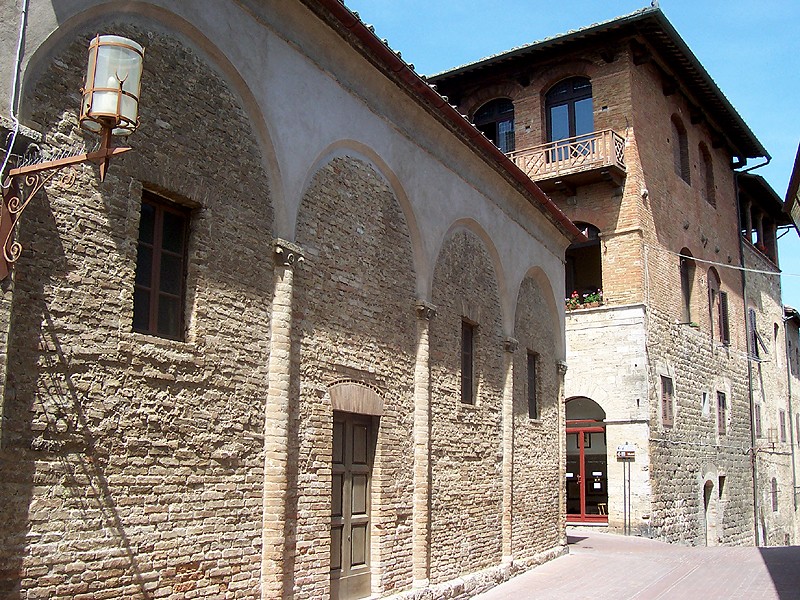
Return to Piazza della Cisterna
We finish our walk back at Piazza della Cisterna, where you can relax with a coffee or another gelato before exploring on your own. From here, you’re well-positioned to shop for local products or simply enjoy the atmosphere of one of Tuscany’s most iconic hill towns. Thanks for walking with me—I hope you enjoyed discovering the history, art, and views that make San Gimignano so special.
Thanks for walking with me!
Thanks for walking with me through San Gimignano. I hope you enjoyed discovering its towers, piazzas, and timeless charm.
If you enjoyed the route, found a hidden gem, or have ideas for improving the experience, I’d love to hear from you! Your insights help me improve future walks and inspire fellow travelers. Please rate this walk using the stars below — and feel free to leave a comment. Thank you! — and happy exploring!


Click here for more JCV Walks
Your journey doesn’t have to end here. Choose another walk and let’s keep exploring together—one step at a time.
JCV Walks in Siena
Walk through one of Italy’s best-preserved medieval cities, from the shell-shaped Piazza del Campo to fresco-filled churches and quiet backstreets. A rich blend of history and atmosphere.
JCV Walks in Pisa
Discover more than just the Leaning Tower with a walk through Pisa’s medieval center, riverside paths, and university district. A compact route with big visual impact.
JCV Walks in Florence
Explore the heart of the Renaissance with walks through historic piazzas, iconic churches, artisan neighborhoods, and riverside gardens. Each route offers a mix of art, architecture, and local life.
Photo Credits
- San Gimignano Arial – By Chensiyuan – Licensed under CC BY-SA 4.0, Source
- Porta San Giovanni – Di I, ThomasZ, Licensed under CC BY 2.5, Source
- Via San Giovanni – Di I, Sailko, Licensed under CC BY 2.5, Source
- Piazza della Cisterna – By cisko66, Licensed under CC BY 3.0, Source
- Gelateria Dondoli – Courtesy Gelateria Dondoli, Source
- Piazza del Duomo – By gaspa – Flickr, Licensed under CC BY 2.0, Source
- Duomo di San Gimignano -By Fiat 500e – Licensed under CC BY 4.0, Source
- Palazzo Comunale – By Francesco Gasparetti from Senigallia, Italy – Licensed under CC BY 2.0, Source
- Viewpoint (Via Casale Agabito) – Di I, Sailko, Licensed under CC BY 2.5, Source
- Parco della Rocca – Di MarkusMark – Licensed under Public Domain, Source
- Church of Sant’Agostino – By I, Sailko, Licensed under CC BY 2.5, Source
- Fonti Medievali – By gaspa – Flickr, Licensed under CC BY-SA 2.0, Source
- Chiesa di San Lorenzo in Ponte – Di MarkusMark – Licensed under Public Domain, Source
- Piazza della Cisterna 2 – By Deror avi – Licensed under CC BY-SA 3.0, Source
- San Gimignano Towers 02 – By LigaDue – Licensed under CC BY-SA 4.0, Source
