A kaleidoscope of color, canals, and quiet charm
Welcome to Burano, the most colorful of the Venetian islands — a place where every house seems to wear a different shade of joy. This walk invites you to slow down and explore the island’s vibrant palette, peaceful canals, and deep-rooted lace-making traditions. While Murano is known for glass, Burano is famous for its thread — and for the way it weaves together beauty, history, and everyday life.
This walk winds through its most photogenic canals and hidden corners, offering glimpses of everyday life behind the painted façades. Along the way, you’ll encounter public art, a leaning bell tower, and the delicate legacy of lace-making that still threads its way through the island’s identity. It’s a gentle loop that rewards curiosity, reflection, and a slower pace.


How to navigate with your mobile device
JCVWalks are designed to be easy to follow on your mobile device. As you walk, you can tap the header or photo for each point of interest to open the location directly in Google Maps. This will help you navigate from your current location to the next point of interest. If you’d like to learn more about any stop along the way, just click the links in the description for additional details and context.
Waiting for Peace (Attesa di Pace)
As you step off the vaporetto, you’re immediately greeted by a splash of color and the gentle rhythm of island life. This is your starting and ending point. We’ll begin by walking straight ahead from the dock to the small park just across the canal, where you’ll find Waiting for Peace (Attesa di Pace), a bronze sculpture by local artist Remigio Barbaro. Originally exhibited at the 1956 Venice Biennale, it depicts a sorrowful young woman and is thought to reflect the grief of those left behind by lost fishermen. From here, cross the nearby bridge and continue along the canal, keeping slightly left, and follow signs toward Via Baldassarre Galuppi — the island’s main street and the heart of Burano’s most colorful scenes.


Fondamenta degli Assassini
Despite its ominous name, the Fondamenta degli Assassini is one of Burano’s most cheerful and colorful streets. Lined with vividly painted houses and fronted by a narrow canal, it’s a quieter stretch of the island that still captures the full charm of Burano’s visual identity. The name dates back to a time when this area was considered less safe — but today, it’s a peaceful and photogenic place to stroll. As you follow the canal, cross one of the wooden bridges and continue toward Via Giudecca, where the walk begins to loop back toward the waterfront.
Casa di Bepi Suà
Just a short detour off the main path brings you to Casa di Bepi Suà — a joyful explosion of color and creativity. Once home to Bepi Barbato, a local candy seller and self-taught artist, the house is painted in a patchwork of bright geometric shapes. It’s not open to the public, but the façade alone is worth the stop. Bepi repainted the house regularly, each time adding new patterns and colors, turning it into a living tribute to Burano’s artistic spirit. After your visit, retrace your steps and continue toward the lively square ahead.

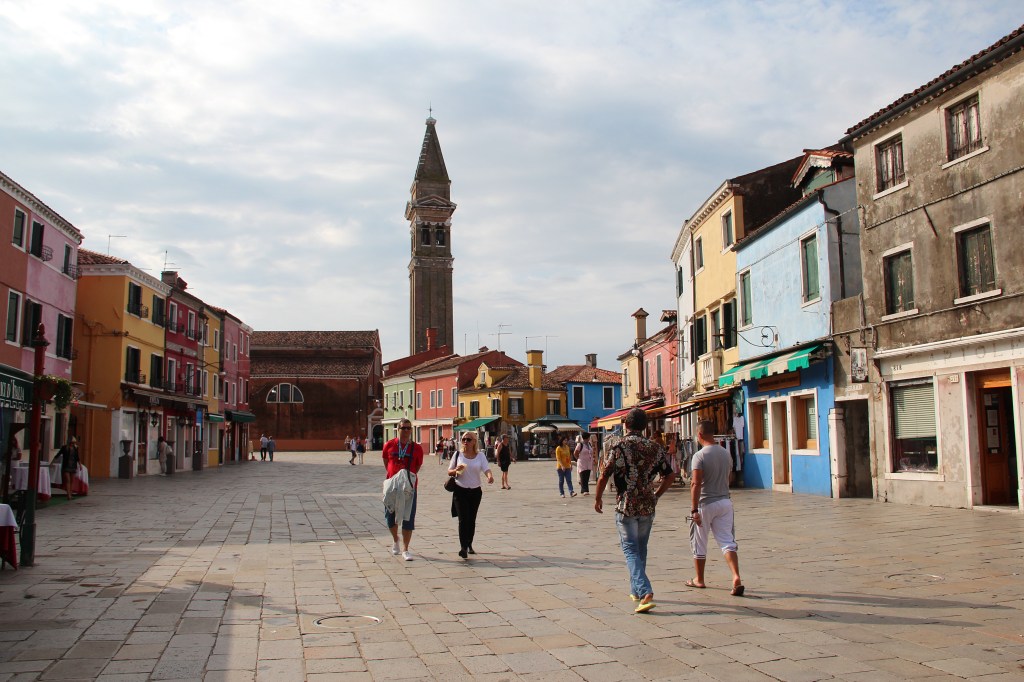
Piazza Baldassarre Galuppi
The heart of Burano is Piazza Baldassarre Galuppi, named after the 18th-century composer born here. This lively square is where locals gather, children play, and the island’s lace-making heritage is proudly displayed. You’ll find the Church of San Martino, the Museo del Merletto, and a few lace shops tucked among the colorful façades. The square is also a great place to observe daily life — from neighbors chatting on benches to artisans working in open doorways. From here, you can explore two important landmarks: the church and the lace museum, both just steps away.
Museo del Merletto (Lace Museum)
The Museo del Merletto offers a fascinating look into Burano’s centuries-old lace-making tradition. Located in the historic Scuola dei Merletti, the museum features antique lace pieces, tools, and photographs that tell the story of the women who made Burano famous for its delicate threadwork. You may even catch a live demonstration of traditional techniques. Though small, the museum provides deep insight into a craft that shaped the island’s identity. The museum is open Tuesday to Sunday from 10:00 AM to 4:00 PM, with last admission at 3:30 PM. Adult admission is €5 and is included in the Venice City Pass. After your visit, return to the square and walk just a few steps to the church.


Church of San Martino & Leaning Bell Tower
Facing the square is the 16th-century Church of San Martino, modest in design but rich in character. Its most striking feature is the leaning bell tower, which tilts dramatically to one side — a reminder of the island’s soft, shifting foundations. Inside the church, look for a painting by Giambattista Tiepolo above the main altar, a rare artistic treasure in such a humble setting. The church remains an active place of worship and a quiet refuge from the bustle of the square. It is open daily from 8:00 AM to 12:00 PM and 3:00 PM to 7:00 PM. Admission is free. When you’re ready, continue along Via Giudecca for the final stretch of the walk.
Via Giudecca & the Canals
Our final stretch takes us along Via Giudecca, another canal-side street lined with colorful homes and flower boxes. This is one of the most peaceful parts of the island, especially in the late afternoon when the light softens and the crowds thin. The views across the water to Mazzorbo — connected by a footbridge — are especially lovely. Take your time crossing a few more bridges and soaking in the quiet beauty of Burano’s backstreets. Soon, you’ll reach one of the island’s most scenic spots.
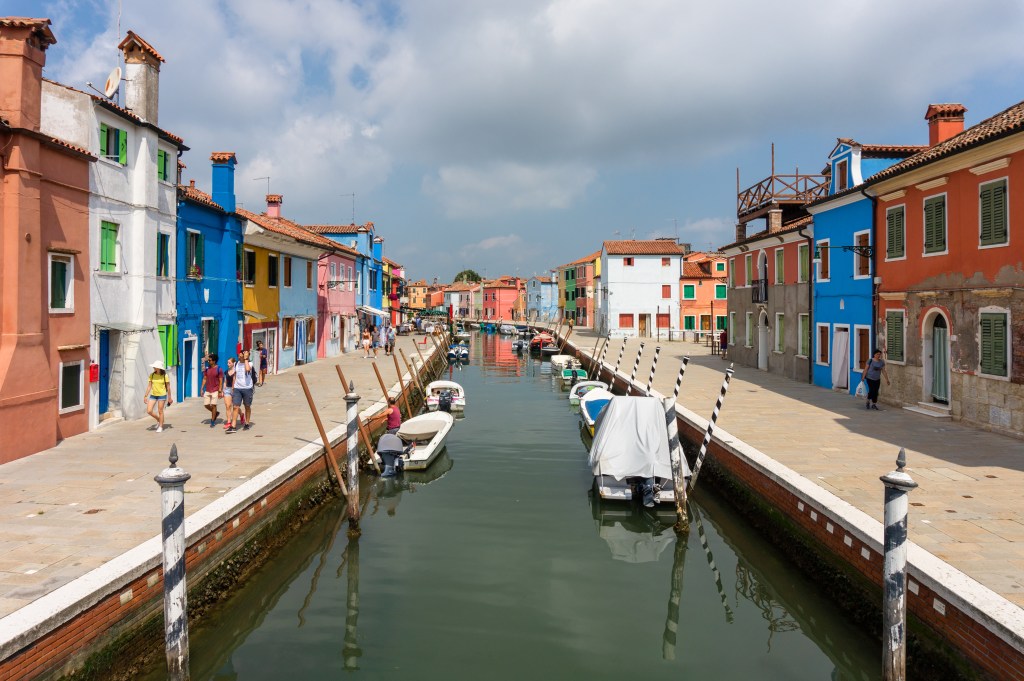

Tre Ponti
At Tre Ponti, three wooden bridges meet over intersecting canals, creating one of the most photographed views on the island. From the center of the bridge, you’ll have panoramic views of Burano’s iconic houses mirrored in the water, with laundry lines strung like bunting between windows. It’s a perfect place to pause and take in the island’s charm from every angle. From here, it’s just a short walk back to the vaporetto stop.
Return to the Vaporetto Stop
As you complete the loop, you’ll return to the Burano vaporetto stop with a new appreciation for Burano’s quiet beauty. Before you leave, take one last look at the island’s colors reflected in the water — a living canvas that changes with every hour of the day.
Thanks for walking with me!
I hope you enjoyed this exploration of Burano — a place where color, craft, and community come together in the most delightful way. Whether you came for the lace, the leaning tower, or the painted houses, I hope you leave with a little more light in your step.
If you enjoyed the route, found a hidden gem, or have ideas for improving the experience, I’d love to hear from you! Your insights help me improve future walks and inspire fellow travelers. Please rate this walk using the stars below — and feel free to leave a comment. Grazie! — and happy exploring!


Click here for more JCV Walks
Your journey doesn’t have to end here. Choose another walk and let’s keep exploring together—one step at a time.
JCV Walks in Murano
Murano is Venice’s glassmaking island, where artisans have shaped molten sand into shimmering works of art for centuries. You’ll find active furnaces, galleries, and the Glass Museum, along with quiet canals and the Church of San Donato. It’s a place where fire, craft, and tradition still thrive.
JCV Walks in Torcello
Torcello is the oldest of the lagoon islands, now home to just a few residents but rich in history. Byzantine mosaics fill the Cathedral of Santa Maria Assunta, and quiet paths lead to Santa Fosca and the Devil’s Bridge. It’s a peaceful retreat steeped in ancient stories.
JCV Walks in Giudecca
Giudecca sits just across the canal from central Venice, offering stunning skyline views and a slower pace. Once home to palaces and factories, it’s now a quiet residential island with leafy promenades, local cafés, and a lived-in feel. It’s Venice from a distance—calm, reflective, and authentic.
Photo Credits
- Tre Ponti Burano – Photo by Abxbay – Licensed under CC BY-SA 3.0, Source
- Piazza Baldassarre Galuppi – Photo by Jean-Pol GRANDMONT – Licensed under CC BY 4.0, Source
- Church of San Martino & Leaning Bell Tower – Photo by MarkusMark – Licensed under CC BY-SA 3.0, Source
- Museo del Merletto (Lace Museum) – Photo by Matthias Süßen – Licensed under CC BY-SA 4.0, Source
- Casa di Bepi Suà – Photo by Hervé Simon – Licensed under CC BY-SA 2.0, Source
- Fondamenta degli Assassini – Photo by Jean-Pol GRANDMONT – Licensed under CC BY 4.0, Source
- Via Giudecca & the Canals – Photo by Marco Ober – Licensed under CC BY-SA 4.0, Source
