Serenity and Spirit Along the Southern Shore
This walk offers a peaceful escape from the crowds across the canal. Once home to factories, convents, and working-class families, the island today blends residential calm with a touch of creative energy. You’ll stroll along wide waterfront paths with sweeping views of Venice, pass boatyards and gardens, and explore quiet lanes where locals live and work. Giudecca isn’t part of the city’s official sestieri, but it feels like its own neighborhood—less polished, more personal, and perfect for a relaxed walk.
Getting to Giudecca
Vaporetto Lines 2 and 4.1 both offer direct service to Giudecca, with the best choice depending on your starting point:
- From San Marco: Line 4.1 from San Zaccaria goes directly to Zitelle, Redentore, and Palanca.
- From Dorsoduro: Line 2 from Zattere or San Basilio crosses the canal directly to Palanca, Redentore, and Zitelle.
- From Piazzale Roma or Ferrovia: Line 2 is the most direct option to Palanca and Redentore making a number of stops along the way.
You may disembark at Giudecca Palanca, Zitelle, or Redentore, all within a short walk from the starting point at Basilica di Santissimo Redentore. From here, we’ll head east along Fondamenta Croce, tracing the quiet southern edge of the island with views across the Giudecca Canal to Dorsoduro and San Marco.
Note: Vaporetto routes and schedules may vary by season or time of day. Always check the official ACTV timetables before departure to confirm the best route.


Basilica di Santissimo Redentore
We begin our walk at the Basilica di Santissimo Redentore, a solemn and majestic church designed by Andrea Palladio in the late 16th century. Built as a votive offering after a devastating plague, the basilica is a symbol of Venice’s spiritual devotion and architectural brilliance. Inside, we’ll find a peaceful interior adorned with works by Tintoretto. The church is especially celebrated during the annual Festa del Redentore in July, when Venetians cross a temporary bridge to honor the city’s survival. Let’s begin our journey eastward along the Fondamenta Croce. The basilica is open Monday to Saturday from 10:30 am to 5:00 pm, admission is €3 for adults, and entry is included with the Venice City Pass.
Casa dei Tre Oci
As we continue along the waterfront, we’ll come upon the Casa dei Tre Oci, a striking neo-Gothic building with three large arched windows (“òci” or eyes) that give the house its name. Built in 1913 by painter Mario de Maria, this former residence now hosts photography exhibitions and cultural events. Its bold façade and artistic programming make it a beacon of Giudecca’s creative spirit. Let’s keep walking toward the eastern tip of the island. Casa dei Tre Oci is open daily from 10:00 AM to 7:00 PM (closed Tuesdays); adult admission is €13, and it is not included in the Venice City Pass.

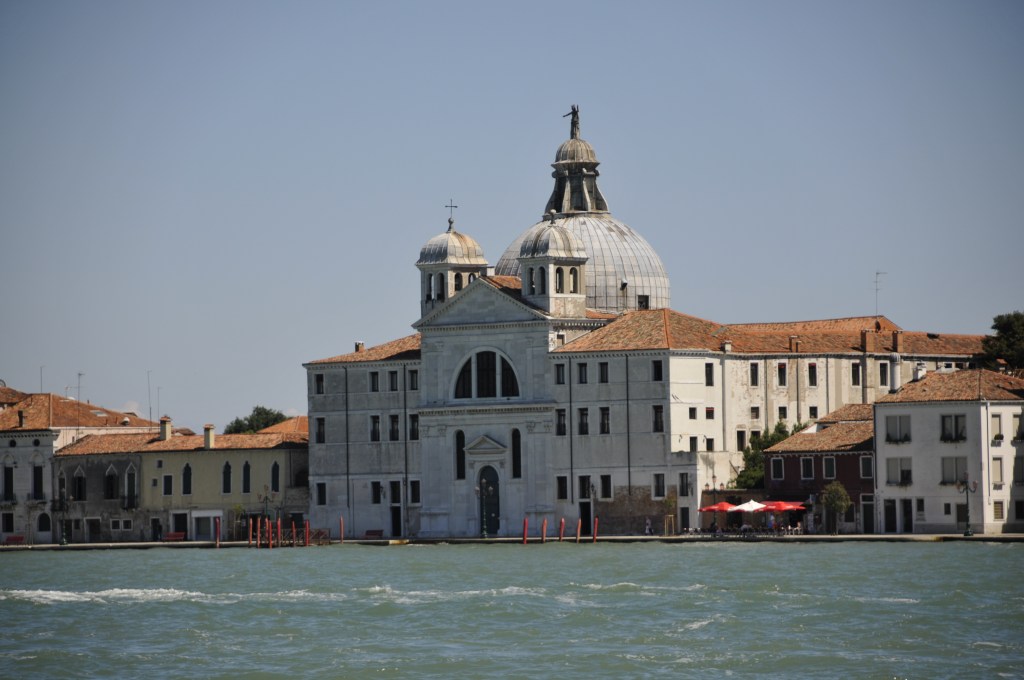
Chiesa di Santa Maria della Presentazione (Le Zitelle)
Looping around the eastern edge of Giudecca, we’ll reach the Chiesa di Santa Maria della Presentazione, commonly known as Le Zitelle. This elegant church was part of a charitable institution founded in the 16th century to support young women without dowries. Designed by Andrea Palladio, its dome and façade are visible from across the canal, and its quiet presence reflects the island’s history of care and community. Let’s continue east to the point overlooking San Giorgio Maggiore before heading back. The church is open daily from April to October (9:00–19:00) and November to March (8:30–18:00), with free admission.
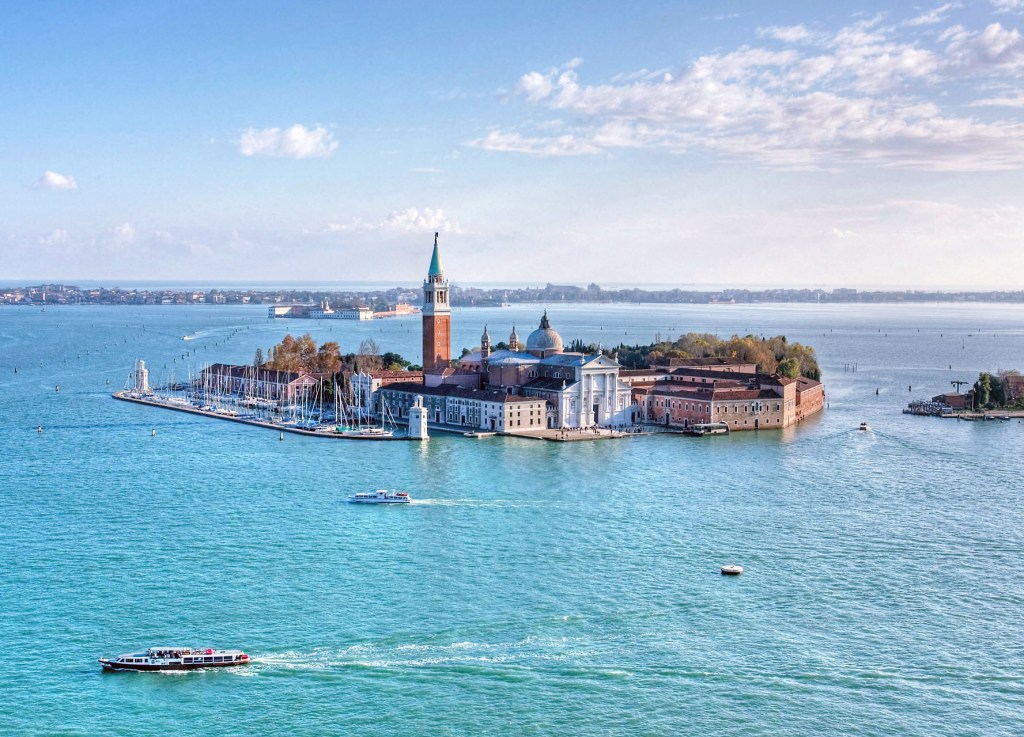
San Giorgio Maggiore
Across the water stands the island of San Giorgio Maggiore, dominated by its 16th-century church designed by Andrea Palladio. The church’s clean white façade and tall bell tower are key examples of Renaissance architecture, known for balance and symmetry.
The island has long been home to a Benedictine monastery of San Georgio and is now a center for art and culture. Inside the church are paintings by Tintoretto, including a striking Last Supper. Visitors can also take an elevator to the top of the bell tower for wide views of Venice and the lagoon. Next door, the Fondazione Giorgio Cini hosts exhibitions, concerts, and academic events. To visit, take Vaporetto Line 2 from the nearby Zitelle or Redentore stop—San Giorgio is just one or two stops away. The Church of San Giorgio Maggiore is open daily from 9:00 to 18:00, with free admission; the bell tower costs €6 for adults and is not included in the Venice City Pass. The Fondazione Giorgio Cini is open daily from 10:00 to 17:00, with admission starting at €14.

Calle Michelangelo
After viewing San Giorgio Maggiore, we’ll turn around and begin retracing our steps west along Fondamenta Zitelle. Just across from the Zitelle vaporetto stop, we’ll turn left onto Calle Campiello Campo di Maite, a narrow lane that leads us inland to Calle Michelangelo, named after the famed artist who once stayed nearby. This quiet stretch offers a glimpse into local life, with peaceful courtyards, laundry lines, and small gardens tucked between homes. It’s a reminder that Giudecca remains a lived-in neighborhood, distinct from the tourist-heavy areas across the canal. We’ll turn at Calle del Gran before returning to the waterfront along Calle del Squero. From there, we’ll turn left and follow Fondamenta San Giacomo, continuing west toward the art district.
CREA Cantieri del Contemporaneo
After returning to the waterfront via Calle del Squero, we’ll turn left and follow Fondamenta San Giacomo, continuing west past repurposed industrial buildings. Here we’ll pass CREA Cantieri del Contemporaneo, a creative hub housed in former warehouses and workshops. This informal art district includes galleries, studios, and event spaces that showcase contemporary art and design. The area reflects Giudecca’s transformation from a working-class and industrial zone to a center of artistic experimentation. We’ll cross the Ponte Longo and turn left onto Calle Strella Ferrando to continue exploring the neighborhood. CREA is open Tuesday through Friday from 11:00 to 18:00, closed on weekends and Mondays; admission varies by exhibition.


Teatro Junghans
We’ll turn inland at Calle Strella Ferrando, crossing the Ponte de la Palada and the Ponte de la Scuole as we weave through the quiet streets. Soon we’ll reach Teatro Junghans, a performing arts venue housed in the former Junghans watch factory, once the largest of its kind in the world. Founded in the late 19th century by the Herion brothers as agents of Junghans Uhren GmbH, the factory produced thousands of timepieces daily and later military components during World War II. After its closure in 1971, the site was repurposed and reopened as a theater in 2005, transforming an old air raid bunker into a space for creativity and community. Today, Teatro Junghans hosts performances, rehearsals, and cultural events, continuing Giudecca’s legacy of reinvention and resilience
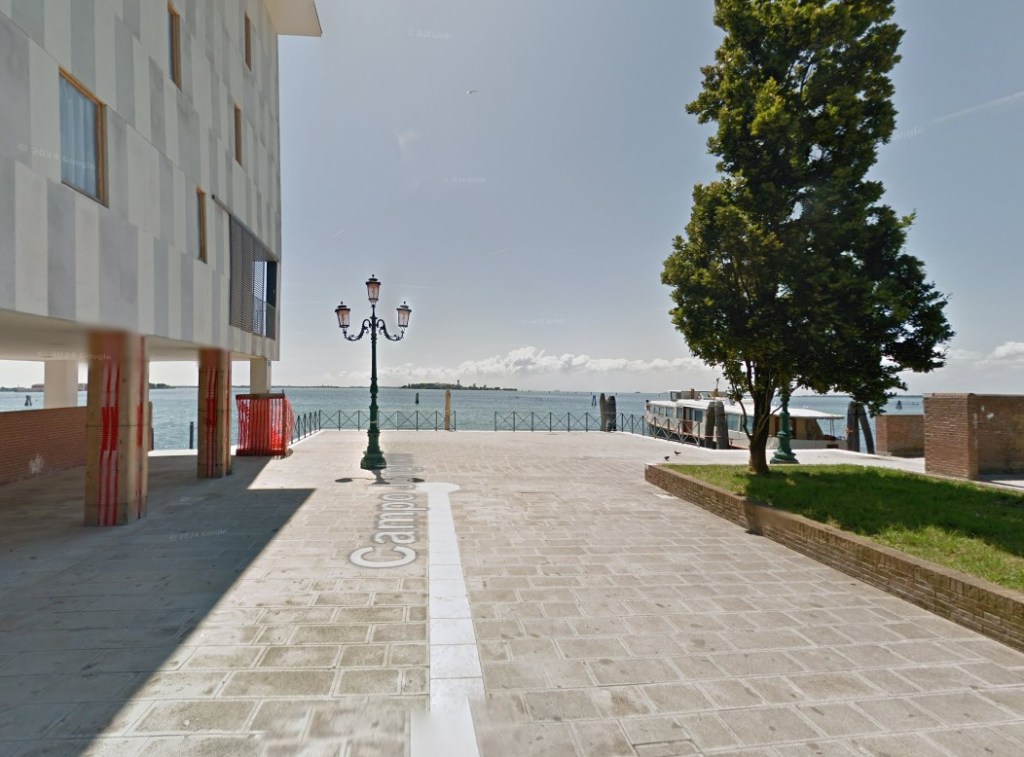
Campo Junghans Viewpoint
Before continuing west, we’ll take a short detour down Campo Junghans, a quiet open space tucked behind the Teatro Junghans complex. This modern residential courtyard, developed as part of the area’s post-industrial renewal, offers a peaceful break from the narrow lanes and historic facades. At the far end of the campo, we’ll find a small landing with open views across the southern lagoon, looking toward the distant mainland and the industrial port of Marghera. It’s a quiet, contemplative spot—perfect for a photo or a moment of rest. After enjoying the view, we’ll return to the main path and cross the Ponte San Cosmo o del Lago Securo, continuing west along Fondamenta de le Convertite.
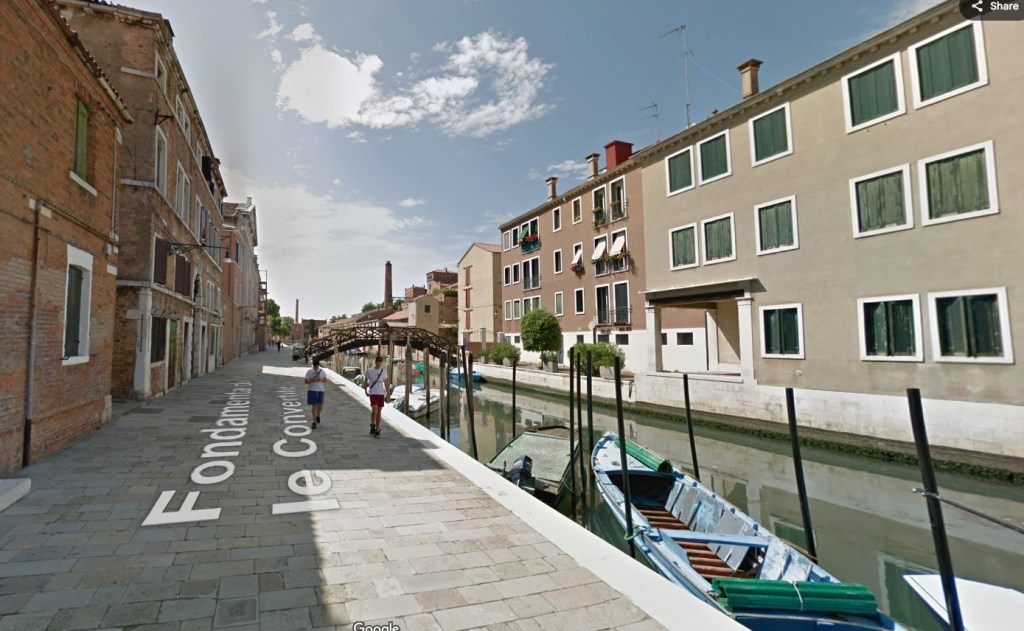
Fondamenta de le Convertite
Crossing the Ponte San Cosmo o del Lago Securo, we’ll continue west along Fondamenta de le Convertite, a path named after the Convento delle Convertite, a 16th-century institution founded to house and reform women who had left lives of prostitution. Originally dedicated to Santa Maria Maddalena, the convent was part of Venice’s broader social policy to isolate and rehabilitate “fallen” women. Over time, the complex became infamous due to abuses by its rector, and was later suppressed by the French in 1806. In 1857, it was converted into a women’s prison—a role it still serves today. The façade is simple and austere, but the site holds deep historical resonance as a place of both redemption and repression. On Thursday mornings, organic produce grown by inmates is sold from a stall in front of the church.
Ciminiera ex Molino Stucky
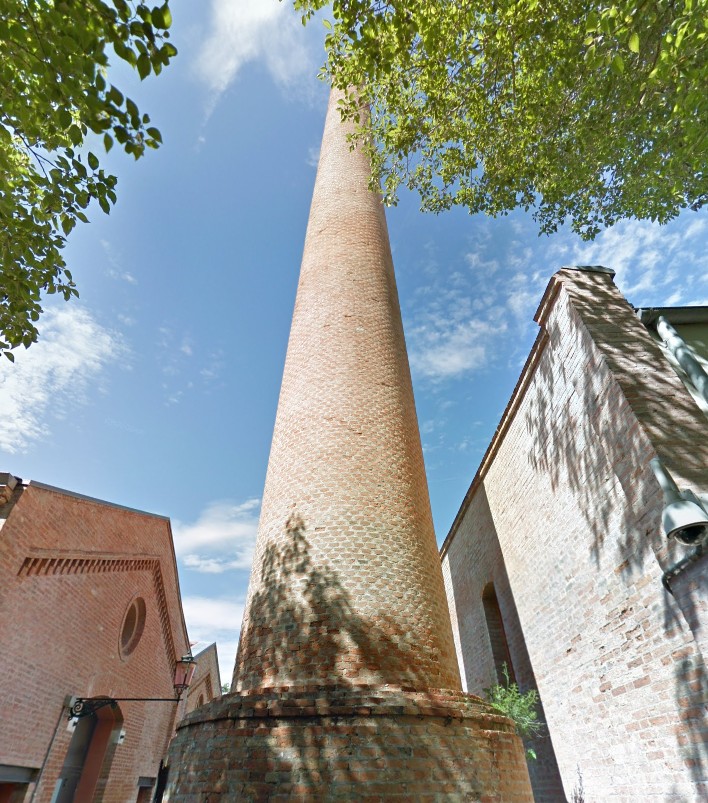
Just across the Ponte de la Convertite is the Ciminiera ex Molino Stucky, the tall chimney of the former Stucky Mill. This red-brick structure is a powerful symbol of Venice’s industrial age and Giudecca’s transformation. Once part of a vast flour mill complex, the chimney now stands as a visual anchor near the Hilton Molino Stucky. Let’s continue west toward Sacca Fisola.
Hilton Molino Stucky
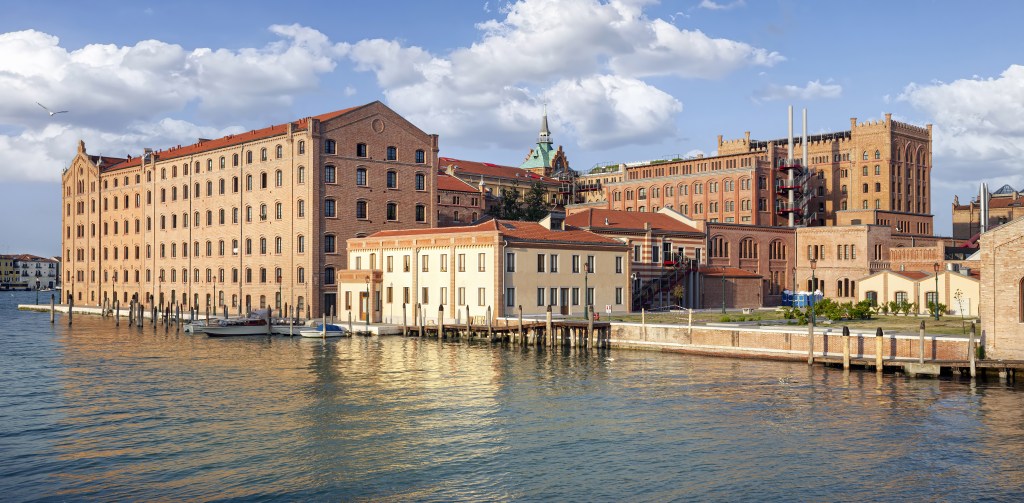
Let’s head back toward the waterfront. Along the way, we’ll admire the massive Hilton Molino Stucky, a former flour mill turned luxury hotel. Built in the late 19th century, the building’s red-brick façade and industrial scale reflect Venice’s economic ambitions during that era. Though not open to casual visitors, the hotel’s Skyline Rooftop Bar is a destination in itself—offering panoramic views of the Venetian skyline from the highest rooftop terrace in the city. The bar is known for its signature cocktails, each crafted to reflect the moods and colors of the Venetian sky. Drinks are priced around €23, making it a splurge, Let’s continue west along Fondamenta S. Biagio.
Chiesa di Sant’Eufemia
As we approach Giudecca Palanca, we’ll stop at the Chiesa di Sant’Eufemia, one of the island’s oldest churches. Dating back to the 9th century, it features a simple yet elegant interior with Byzantine and Renaissance influences. The church is a quiet place to pause before concluding our walk in Giudecca. The church is currently not open to visitors and is included here as a navigational waypoint.

Food & Drink Suggestions
There are a number of options for Aperitivo or dinner before boarding your vaparetto. Below are just a few:
- Aperitivo Options in Giudecca
- Bar da Monica. A true Venetian neighborhood bar, perfect for an Aperol Spritz or a glass of wine. Locals gather here around 6 PM for aperitivo, and the staff is known for being warm and welcoming
- Skyline Rooftop Bar – Hilton Molino Stucky. Offers 360-degree views of Venice and the lagoon—especially stunning at sunset. Ideal for a more elegant aperitivo with cocktails and small bites
- Majer Giudecca. Known for its bakery and wine selection, Majer offers a cozy spot for aperitivo with outdoor seating and a mix of locals and visitors
- Dinner Options in Guidecca
- La Palanca. Located at Fondamenta della Palanca, Giudecca 448. Vibe: Local trattoria with a canal-side terrace and a front-row seat to the sunset over the Giudecca Canal. Cuisine: Simple, fresh Venetian seafood and pasta. Great value, authentic feel, and unbeatable views. Quick vaporetto ride from Zattere (just across the Accademia Bridge).
- Trattoria Altanella. Located at Calle delle Erbe, Giudecca 268. Vibe: Family-run trattoria with a peaceful garden terrace and some canal-side tables. Traditional Venetian dishes, especially seafood. A hidden gem with a quiet, romantic atmosphere. ~10-minute walk from LaPalanca east along the Giudecca waterfront just before Ponte Longo.
Departing Giudecca
From Palanca, you have several options to return to your starting point:
- To Dorsoduro: Board Vaporetto Line 2 at Giudecca Palanca and disembark at Zattere or San Basilio.
- To San Marco: Take Vaporetto Line 4.1 or 2 from Giudecca Palanca to San Zaccaria or San Marco Giardinetti.
- To Piazzale Roma or Santa Lucia Station: Use Line 4.1 or Line 2 from Giudecca Palanca, both of which stop at Ferrovia and Piazzale Roma.
Important: Always check the direction of travel before boarding. Vaporetto lines often run in loops, and taking the wrong direction can add 30+ minutes to your journey.
Thanks for walking with me!
I hope you enjoyed exploring one of Venice’s most peaceful and authentic neighborhoods—Giudecca. This walk offers a rich blend of history, art, and local life. Along the way, we’ve admired canal views, discovered hidden courtyards, and traced the transformation of Giudecca from a working-class island to a vibrant cultural enclave.
If you enjoyed the route, found a hidden gem, or have ideas for improving the experience, I’d love to hear from you! Your insights help me improve future walks and inspire fellow travelers. Please rate this walk using the stars below — and feel free to leave a comment. Grazie! — and happy exploring!


Click here for more JCV Walks in Venice
Your journey doesn’t have to end here. Choose another walk and let’s keep exploring together—one step at a time.
JCV Walks in Dorsoduro
Cross the canal to Giudecca, a peaceful island with wide waterfront paths, local artisan studios, and stunning views back toward the heart of Venice.
JCV Walks in Venice (All)
Explore all of Venice’s six districts (sestieri)
Photo Credits
- Chiesa del Redentore (Venice) – Photo by Didier Descouens – Licensed under CC BY-SA 4.0, Source
- Casa dei Tre Oci – Photo by Till Niermann – Licensed under CC BY 3.0, Source
- Chiesa di Santa Maria della Presentazione (Le Zitelle) – Photo by Wolfgang Moroder – Licensed under CC BY-SA 3.0, Source
- View of San Giorgio Maggiore – Photo by Sergey Ashmarin, licensed under CC BY-SA 4.0, source
- Fondamenta San Giacomo and Calle Michelangelo – Captured via Google Maps Street View, Source Google Street View, © Google
- CREA Cantieri del Contemporaneo – Spiral by By alexandra kolackova, Source
- Teatro Junghans – Photo byAbxbay – Licensed under CC BY-SA 3.0, Source
- Campo Junghans – Captured via Google Maps Street View, Source Google Street View, © Google
- Ex Chiesa dei Santi Cosma e Damiano –
- Fondamenta de le Convertite – Captured via Google Maps Street View, Source Google Street View, © Google
- Ciminiera ex Molino Stucky – Captured via Google Maps Street View, Source Google Street View, © Google
- Sacca Fisola – Photo by Joanbanjo – Own work, CC BY-SA 3.0, Source
- Hilton Molino Stucky – Photo by Didier Descouens – Licensed under CC BY-SA 4.0, Source
- Chiesa di Sant’Eufemia – Photo by Didier Descouens – Licensed under CC BY-SA 4.0, Source
