Where Venice Meets the Mainland
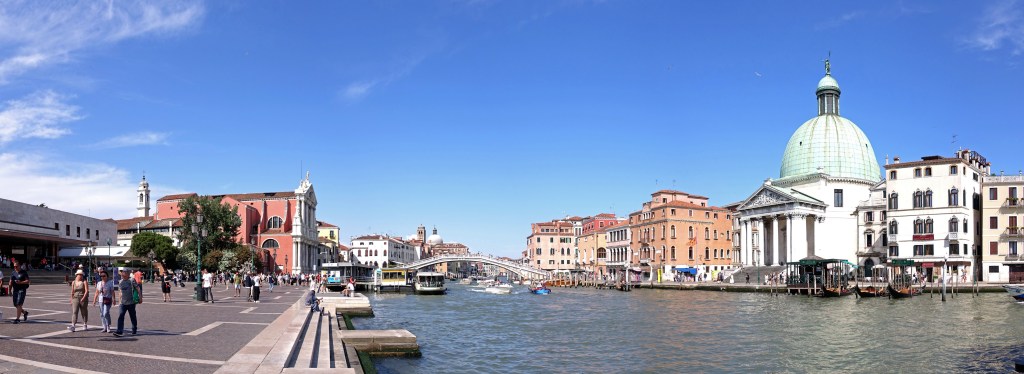
Santa Croce serves as a gateway for many visitors arriving by train or car yet remains largely residential and less trafficked than neighboring districts. The area blends medieval churches, leafy gardens, and hidden squares with a lived-in feel that reflects Venice beyond the postcard. With its mix of history, understated beauty, and everyday life, Santa Croce offers a more intimate perspective on the city’s layered identity.


How to navigate with your mobile device
JCVWalks are designed to be easy to follow on your mobile device. As you walk, you can tap the header or photo for each point of interest to open the location directly in Google Maps. This will help you navigate from your current location to the next point of interest. If you’d like to learn more about any stop along the way, just click the links in the description for additional details and context.
Campo Sant’ Angelo
We will begin our walk in San Marco at Campo Sant’Angelo, a quiet square tucked between the lively districts of San Marco and Dorsoduro. Historically a hub for local artisans and merchants, the campo today offers a peaceful contrast to the nearby tourist corridors, with its modest church and shaded benches inviting a moment of calm before we set off.
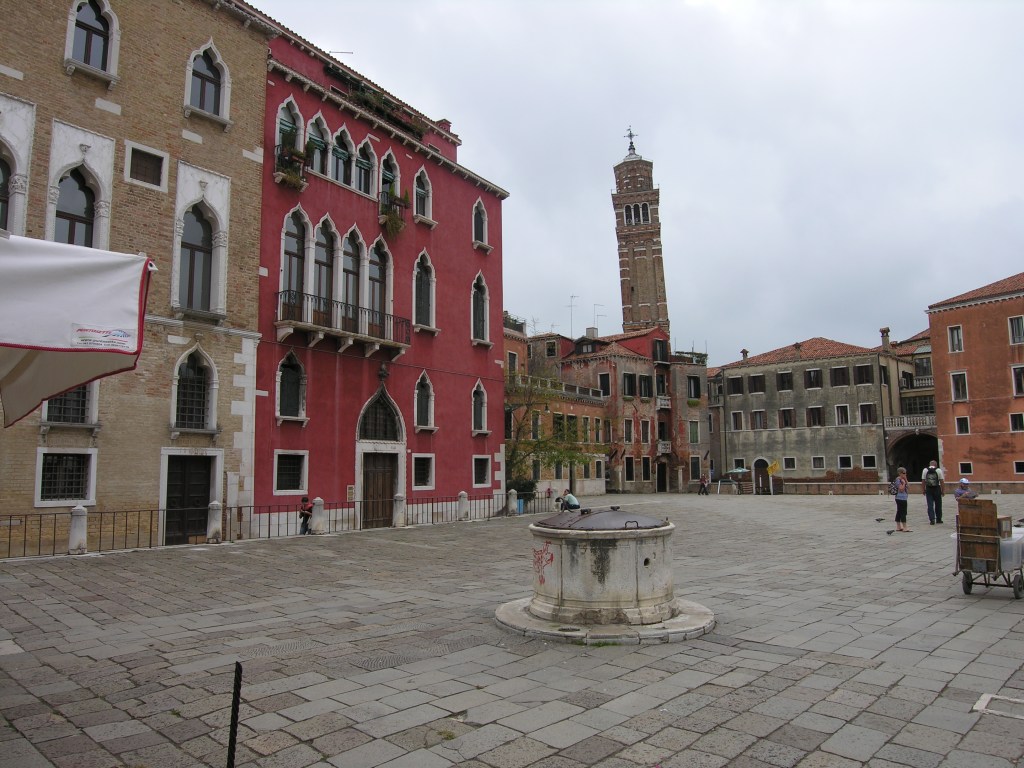
From here, we’ll make our way westward through lesser-known canals and campos, enjoying a scenic and varied route that includes a traghetto ride across the Grand Canal—a uniquely Venetian experience that adds a touch of adventure to the journey and connects us to the quieter rhythms of Santa Croce.
Traghetto San Tomà Crossing
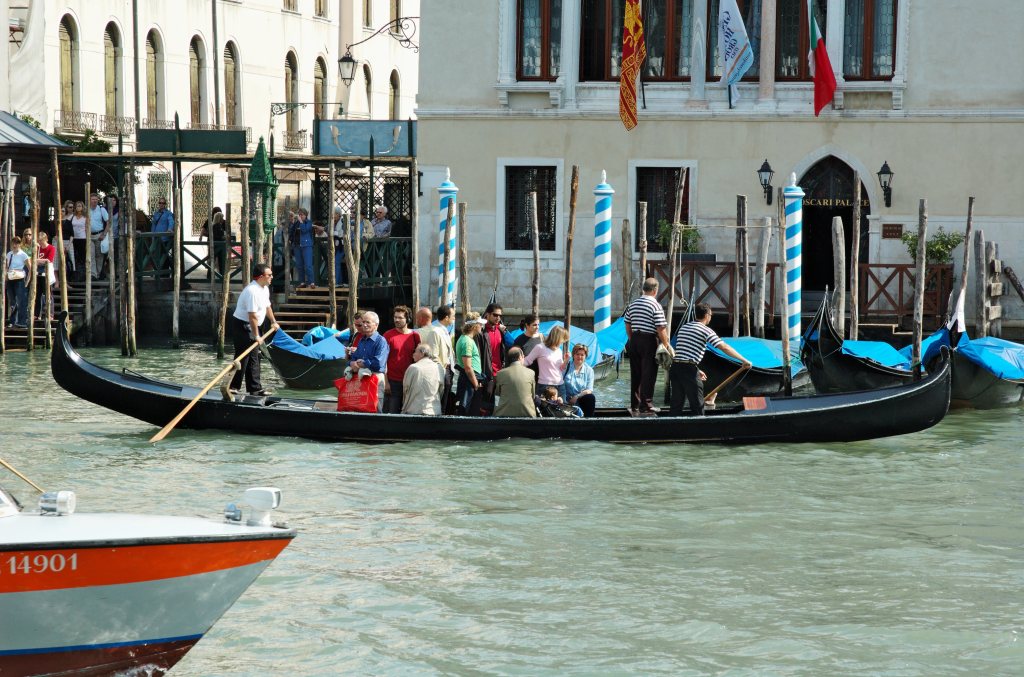
As we reach the Grand Canal, we’ll board the Traghetto San Tomà, one of the few remaining gondola-style ferries still used by Venetians for quick crossings. These short rides offer a rare opportunity to stand aboard a gondola and experience the Grand Canal as locals have for centuries. From our position on the San Marco side, we’ll cross westward toward San Polo, with several notable palazzi coming into view.
The Venetian Traghetto
The traghetto (literally “ferry” in Italian) is a traditional gondola-style boat used to shuttle passengers across the Grand Canal at designated crossing points. In a city with only four main bridges spanning the canal, traghetti have long served as a practical and affordable way for Venetians to move between districts. While their numbers have dwindled over the years, a handful still operate today—offering visitors a short, authentic ride that echoes centuries of daily life in Venice.
How to Ride the Traghetto
- Payment: Fares are typically €2 for tourists, paid in cash directly to the gondolier. No tickets or reservations are needed.
- Boarding: Wait at the designated traghetto stop (look for a small dock with a sign). Let disembarking passengers off first, then step aboard carefully—gondoliers may offer a hand.
- Standing vs. Sitting: Locals often stand, but visitors are welcome to sit on the benches along the sides for balance and comfort.
- Deboarding: The ride lasts just a minute or two. Step off carefully when the gondolier signals, as the boat may shift slightly with movement.
Campo San Toma
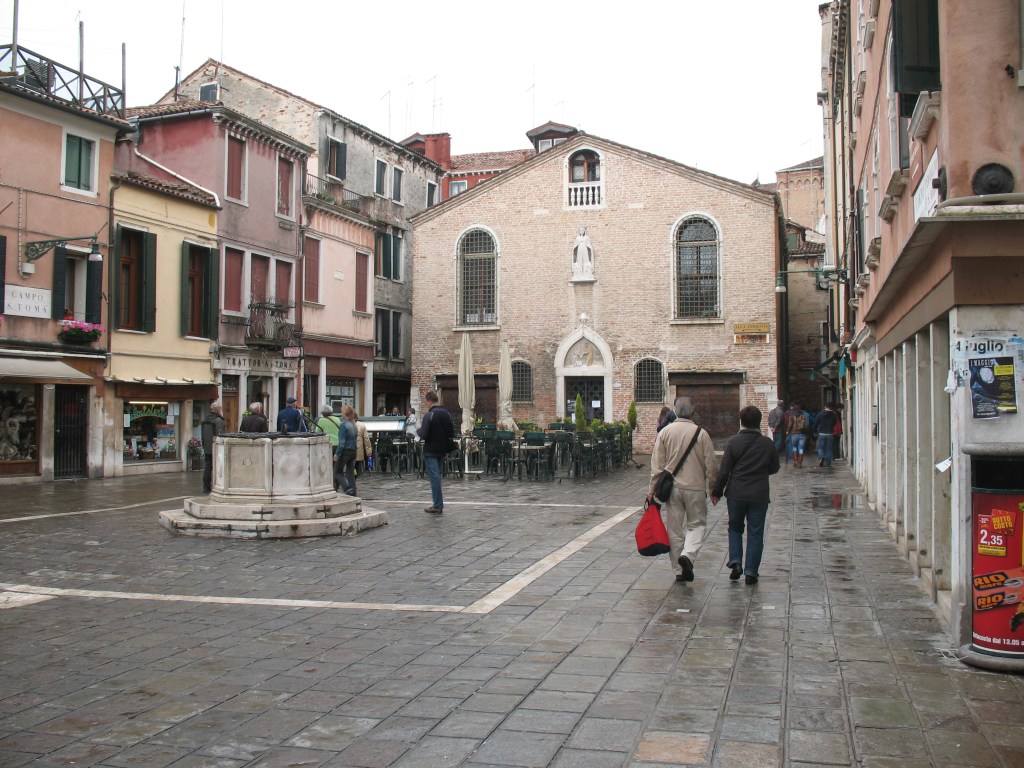
After disembarking from the traghetto, we’ll arrive at Campo San Tomà, a modest but lively square in the San Polo district. Historically a hub for artisans and small merchants, the campo today offers a glimpse into everyday Venetian life, with local cafés and shops tucked around its edges. It’s a good spot to pause briefly and orient ourselves before continuing west.
Chiesa Parrocchiale di San Pantalon
Just a few minutes’ walk from Campo San Tomà, we’ll reach the Chiesa di San Pantalon, a parish church with an unassuming exterior that hides one of Venice’s most astonishing artistic treasures. Inside, the ceiling is covered by a massive oil-on-canvas painting—The Martyrdom of Saint Pantaleon—created by Gian Antonio Fumiani over two decades in the late 17th century. It’s considered one of the largest and most dramatic ceiling paintings in Europe, depicting the saint’s ascent to heaven in vivid, theatrical detail. Entry is free, and the church is usually quiet, offering a contemplative break in the walk. The church is open Monday to Saturday from 10:00 AM to 12:30 PM and 3:30 PM to 6:30 PM. It is closed on Sundays except for religious services. Entry is free, though a small donation (€1–2) is encouraged to illuminate the ceiling painting.

From here, we’ll continue west along Calle San Pantalon, cross the Ponte San Pantalon, and turn onto Fondamenta del Gaffaro. As we cross the bridge and begin walking along the fondamenta, we officially enter the district of Santa Croce.
Chiesa di San Nicolò da Tolentino
Here stands the imposing Chiesa di San Nicolò da Tolentino, a Baroque masterpiece begun in 1590 by Vincenzo Scamozzi and completed in 1714. Its most striking feature is the massive freestanding Corinthian portico—unique in Venice—designed by Andrea Tirali. Inside, you’ll find richly decorated chapels and notable artworks, including paintings by Johann Liss and Bernardo Strozzi, and the high altar by Baldassare Longhena. The church also houses the tombs of several Venetian doges and a grand Baroque organ built in 1754. It is open Monday to Friday from 8:30 AM to 12:00 PM and 4:30 PM to 6:30 PM, and Sunday from 4:30 PM to 6:30 PM. Admission is free.

Consider pausing at nearby Bacareto da Lele, a beloved local spot known for its high-quality yet budget-friendly cicchetti and wine. Just steps from the church, this tiny bacaro draws a lively crowd of students, workers, and travelers alike. There was a long line when we visited. We didn’t wait, but that is usually a good sign.
Fondamenta dei Tolentini
Before leaving the area, I suggest taking a brief detour along the Fondamenta dei Tolentini, a quiet canal-side promenade lined with university buildings and local cafés. This stretch offers a glimpse into everyday Venetian life, with students lingering over espresso and locals going about their routines. It’s a peaceful and authentic corner of the city, just steps from the busier Piazzale Roma.

Giardini Papadopoli
From the Tolentini, we’ll continue west along the Rio dei Tolentini, passing the university buildings and crossing the small Ponte dei Tolentini. Just ahead, we’ll enter the leafy Giardini Papadopoli, one of the few public gardens in Venice, located near Piazzale Roma. Originally part of a private estate, they were redesigned in the 19th century and now offer shaded paths, sculptures, and benches. The gardens provide a rare green space in a city dominated by stone and water, making them a refreshing stop. Entry is free, and the gardens are open daily. This is a great place to rest and enjoy a quiet moment surrounded by nature.

As we reach the Ponte della Costituzione (Constitution Bridge), travelers curious about Venice’s contemporary infrastructure and cruise port area can take a short detour before continuing the walk. Instead of crossing the bridge, turn left and follow the Fondamenta Santa Chiara, a wide pedestrian path that runs alongside the canal and offers views of the Marittima cruise terminal. Use the links below to guide you through this short half-mile loop. Or skip it and click the link to the Constitution Bridge,
Optional Cruise Terminal Loop
Chiesa del Santissimo Nome di Gesù
Click the link above for the first navigational waypoint. Chiesa del Santissimo Nome di Gesù. A small 17th-century Jesuit church with a quiet, devotional interior reflecting the Counter-Reformation’s emphasis on personal piety. We will walk under the Ponte della Libertà, the only vehicular bridge connecting Venice to the mainland, offering a symbolic view of the city’s connection to the outside world.
We will walk under the Venice People Mover, a short elevated tram that connects Piazzale Roma, Tronchetto parking island, and the cruise terminal. It’s a quick and practical way to move between Venice’s transport hubs and the entrance to the pedestrian city. The ride cost €1.50 (or use ACTV Pass if interested. In the distance, you may see cruise ships in port at the Marittima Cruise Terminal.
Chiesa Sant’Andrea della Zirada
The second waypoint to guide the walk is the Chiesa Sant’Andrea della Zirada. A striking 14th-century Gothic church with a rose window and pointed arches, one of the few remaining examples of Venetian Gothic architecture in this part of the city.
Constitution Bridge
We will now head back to the Constitution Bridge along the Rio Terà Sant’Andrea. Once a canal, it is now a broad pedestrian thoroughfare that reflects Venice’s 19th-century urban planning efforts. It’s lined with local shops, modern residences, and civic buildings—offering a rare glimpse of everyday Venetian life beyond the tourist zones. Click the link below to return to the Main Walk.
Constitution Bridge
After exploring the gardens or the optional walk to view the cruis terminal, we will walk over the Ponte della Costituzione, the newest and most controversial of Venice’s four bridges spanning the Grand Canal. Designed by Santiago Calatrava, this arched truss bridge was inaugurated in 2008 to mark the 60th anniversary of the Italian constitution. It connects Piazzale Roma to the train station and offers panoramic views of the canal. Built with steel, glass, and Istrian stone, its modern design sparked debate for clashing with Venice’s historic architecture and for being difficult to navigate, especially for wheelchair users. Despite its rocky reception, it has become a symbolic gateway for visitors arriving in Venice.
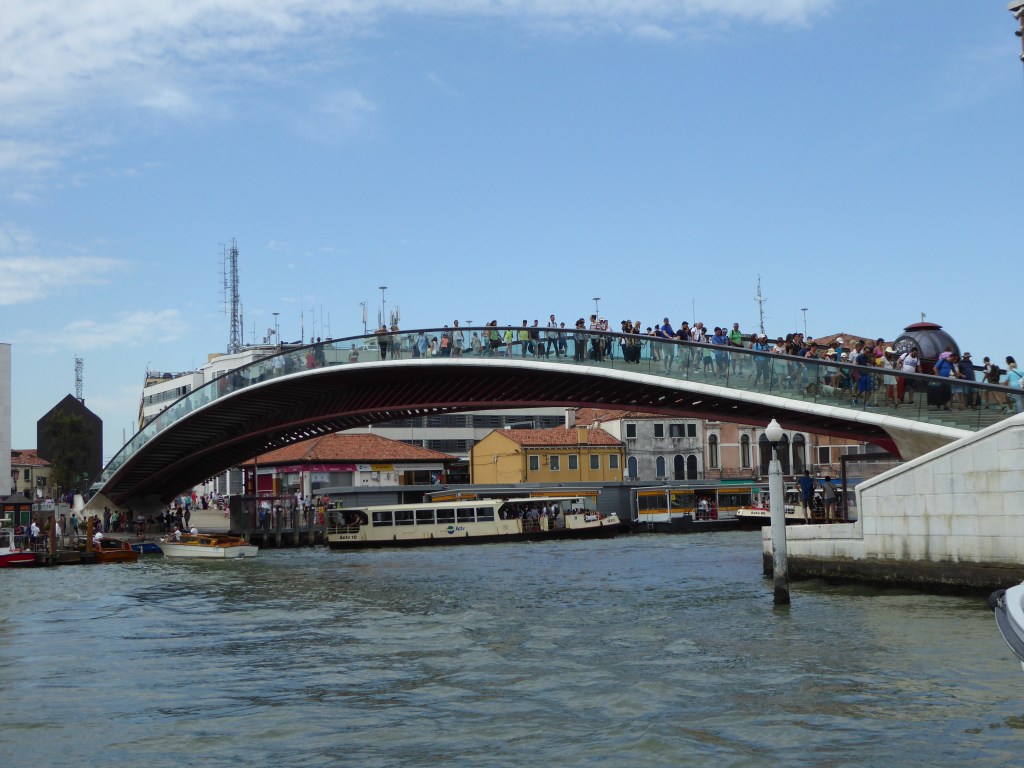
Venezia Santa Lucia
The Venezia Santa Lucia, Venice’s main train station, serves as the city’s connection to the mainland and beyond. It was built in the 1860’s and sits in the Cannaregio district. The adjacent Piazzale Roma serves as the gateway to the historic center and offers immediate access to the Grand Canal. Each year, over 30 million passengers pass through this station making it one of Italy’s busiest rail hubs and a symbolic gateway to the lagoon city. While functional in design, its location and the views from its steps make it a noteworthy stop on the walk—even if you’re not arriving by train.

Ponte Degli Scalzi
We will resume our walk by crossing the Ponte degli Scalzi, one of only four bridges that span the Grand Canal. Its name—“Bridge of the Barefoot Monks”—comes from the nearby Chiesa degli Scalzi, once home to the Discalced Carmelites. The current bridge, completed in 1934 by engineer Eugenio Miozzi, replaced an earlier Austrian iron bridge from 1858. Built from Istrian stone, its elegant single arch was inspired by the design of the Rialto Bridge. Today, it serves as a vital pedestrian link between Santa Croce and Cannaregio, offering sweeping views of the Grand Canal and the bustling Santa Lucia train station.

Chiesa de San Simion Piccolo
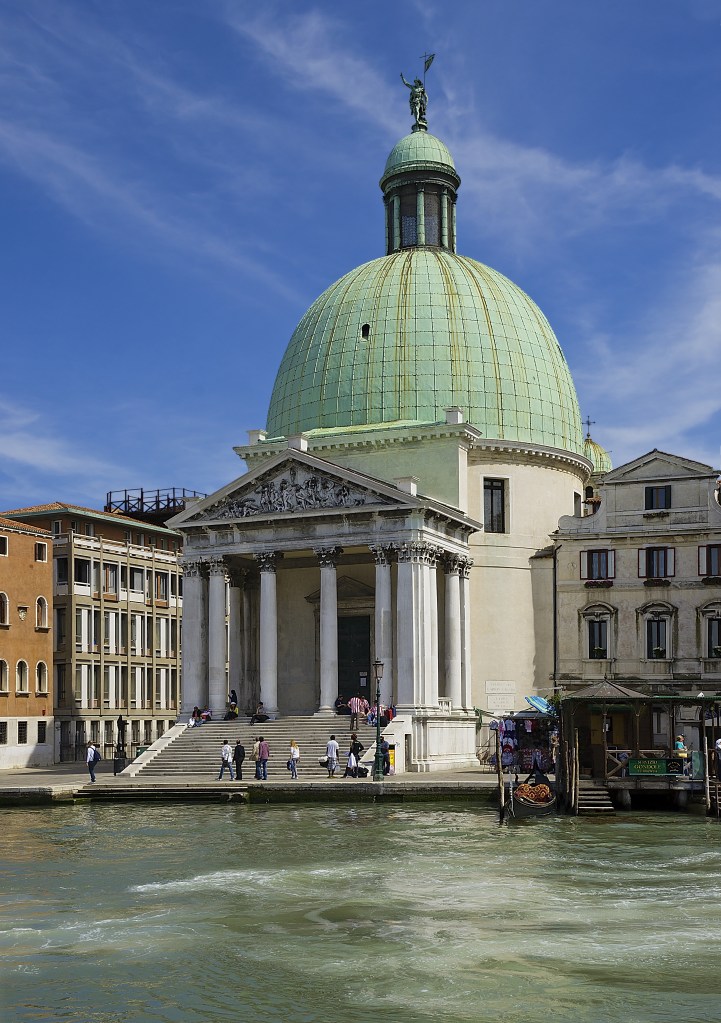
Just after crossing the Ponte degli Scalzi we will pause briefly to admire the Chiesa di San Simeon Piccolo, one of Venice’s most visually striking churches. Located directly across from the Santa Lucia train station, this Neoclassical gem was built between 1718 and 1738 by Giovanni Antonio Scalfarotto. Its design draws inspiration from the Pantheon in Rome, with a grand Corinthian portico and a soaring green copper dome that dominates the skyline. The church’s circular plan and domed rotunda reflect Byzantine influences, while the interior features several chapels adorned with works by Antonio Marinetti and Francesco Polazzo. One of its most unique features is the octagonal crypt, containing frescoes and burial chapels for prominent parishioners. Though often overlooked by tourists rushing into Venice, San Simeon Piccolo offers a quiet moment of reflection and architectural grandeur right at the city’s gateway. Admission is free, and the church is open daily from 3:30 PM to 7:00 PM.
Calle Ca’ Zusto
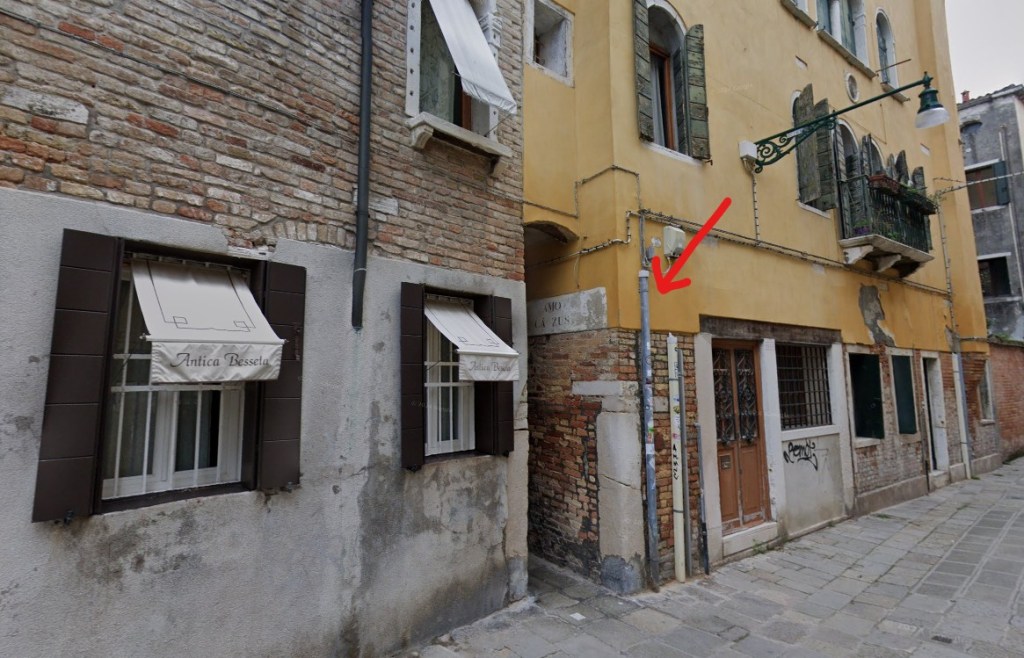
From the church, we’ll continue southeast along Fondamenta San Simeon Piccolo, then turn onto Salizada de Ca’ Zusto, a broad paved street. Just ahead, tucked discreetly to the side, is Calle Ca’ Zusto, the narrowest street in Santa Croce. Measuring just 67 centimeters wide (about 2.2 feet), this tiny alley is barely wide enough for a single person to pass through. It’s a delightful photo opportunity and a whimsical reminder of Venice’s medieval street planning. The contrast between the broad salizada and this slender passage adds to its charm.
Chiesa di San Giacomo da Orio
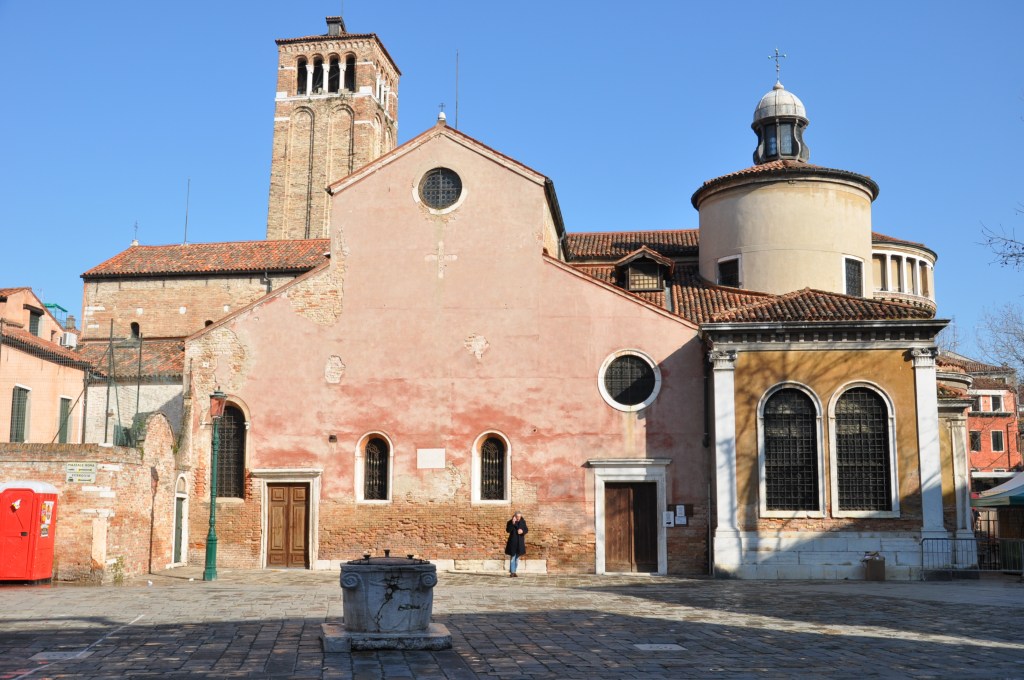
After slipping through the narrow Calle Ca’ Zusto, we’ll continue southeast along Rio Terà del Cristo, a quiet residential street lined with small shops and local homes. Soon, we’ll reach the Ponte del Savio, a charming stone bridge arching over the Rio di San Giacomo. Crossing here brings us directly into Campo San Giacomo where we will find the Chiesa di San Giacomo da Orio, a lesser-known but historically rich church. Dating back to the 9th century, it features a unique wooden ceiling shaped like a ship’s hull and artworks by Lorenzo Lotto and other Venetian painters. The church is open Monday to Saturday from 10:30 AM to 1:30 PM and 2:30 PM to 5:00 PM. Adult admission is €3. Its quiet location and architectural details make it a rewarding stop for those interested in Venice’s religious and artistic diversity.
Chiesa di San Stae
From Campo San Giacomo da Orio, we’ll head northeast along Salizada San Stae, which leads us directly to the Chiesa di San Stae, facing the Grand Canal. The church’s full name is Sant’Eustachio, but it’s commonly known as San Stae. Built in the early 18th century, its striking Baroque façade was designed by Domenico Rossi and funded by the patrician Doge Alvise Mocenigo. The interior features a series of chapels with works by prominent Venetian painters, including Tiepolo, Ricci, and Piazzetta. Admission is included with the Chorus Pass, and the church’s location along the canal makes it a scenic and worthwhile stop. The church is open Monday to Saturday from 10:00 AM to 5:00 PM, and closed on Sundays and major holidays. Adult admission is €3.

Our walk concludes at the Chiesa di San Stae, a canal-facing Baroque church with a striking façade and a quiet atmosphere. Its location along the Grand Canal makes it a perfect place to pause and reflect on the walk through Santa Croce. From here, you have several good options depending on your interests and energy level:
Thanks for walking with me!
I hope you enjoyed this walk through Santa Croce, where quiet corners, neighborhood parks, and historic churches meet glimpses of Venice’s modern transportation and its connection to the mainland. It’s a route that blends the city’s past and present in a way that’s both peaceful and revealing.
If you enjoyed the route, found a hidden gem, or have ideas for improving the experience, I’d love to hear from you! Your insights help me improve future walks and inspire fellow travelers. Please rate this walk using the stars below — and feel free to leave a comment. Grazie! — and happy exploring!


Click here for more JCV Walks in Venice
Your journey doesn’t have to end here. Choose another walk and let’s keep exploring together—one step at a time.
Bar, Ca’ Pesaro
If you want to relax a but with a caffe or spritz, check out the nearby Bar, Ca’ Pesaro, a quiet café tucked into the first floor of the Ca’ Pesaro museum, a Baroque palace turned modern art museum, offering a scenic spot along the Grand Canal. The museum itself houses works by Gustav Klimt, Auguste Rodin, and other modern artists. The museum is open daily from 10:00 AM to 6:00 PM (last entry at 5:00 PM), and closed on Mondays. Adult admission is €14 and is included in the Venice City Pass. The café fhas an covered outdoor patio on the canal and is accessible without entering the museum galleries, making it a great spot to relax and watch the activity on the Grand Canal.
JCV Walks in Canaregio
Right at the entrance of the church, you’ll find the San Stae Vaparetto. Here, you can take Line 1 across the Grand Canal to Campo San Marcuola in the Cannaregio district or Lines 2 or A to other destinations in Venice.
JCV Walks in San Marco
Continue to along the Salizada San Stae and follow signs toward Ponte Rialto. Along the way, you can stop at the Mercato di Rialto, Venice’s historic food market, which is lively in the mornings and early afternoons. There, you can walk with me through the San Marco district, the ceremonial and cultural heart of Venice.
JCV Walks in San Polo
Continue to along the Salizada San Stae and follow signs toward Ponte Rialto. Along the way, you can stop at the Mercato di Rialto, Venice’s historic food market, which is lively in the mornings and early afternoons. Here you can continue to walk with me through the San Polo district, to explore the rich cultural and commercial legacy of Venice.
Photo Credits
- Santa Croce View – By Tiia Monto, Licensed under CC BY-SA 3.0, Source
- Campo Sant’ Angelo – By Lothar John, Licensed under CC BY-SA 3.0, Source
- Traghetto Gondola – By Gary Houston – Licensed under CC0, Source
- Campo San Toma – By Hans-Jürgen Hübner – Licensed under, CC BY-SA 3.0, Source
- Chiesa Parrocchiale di San Pantalon – By Didier Descouens – Licensed under CC BY-SA 4.0, Source
- Chiesa di San Nicolò da Tolentino – By Didier Descouens – Licensed under CC BY-SA 4.0, Source
- Fondamenta dei Tolentini – By Jorge Franganillo – CC BY 2.0, Source
- Giardini Papadopoli – Photo by Didier Descouens – Licensed under CC BY-SA 4.0, Source
- Ponte della Libertà – Photo by Didier Descouens – Own work, CC BY-SA 4.0, Source
- Ponte Costituzione Venezia – By Abxbay – Licensed under CC BY-SA 4.0, Source
- Stazione Santa Lucia Venice – By Gary Houston – Licensed under CC0, Source
- Venice Cruise Terminal – Photo by Mario Roberto Durán Ortiz – Licensed under, CC BY-SA 4.0, Source
- Ponte Degli Scalzi – By Jean-Pol GRANDMONT – Licensed under CC BY 4.0, Source
- Chiesa San Simeone Piccolo – Photo by By Didier Descouens – Licensed under CC BY-SA 4.0, Source
- Calle Ca’ Zusto – Captured via Google Maps Street View, Source Google Street View, © Google
- Chiesa di San Giacomo da Orio – By JUMPINVENICE – Licensed under CC BY-SA 2.0, Source
- Chiesa di San Stae – By Didier Descouens – Licensed under CC BY-SA 4.0, Source
- Ca’ Pesaro – Photo by Wolfgang Moroder. – Licensed under CC BY-SA 3.0, Source
- Pointe De Rialto- By kallerna – Licensed under CC BY-SA 4.0, Source
