Land of Light and Joy
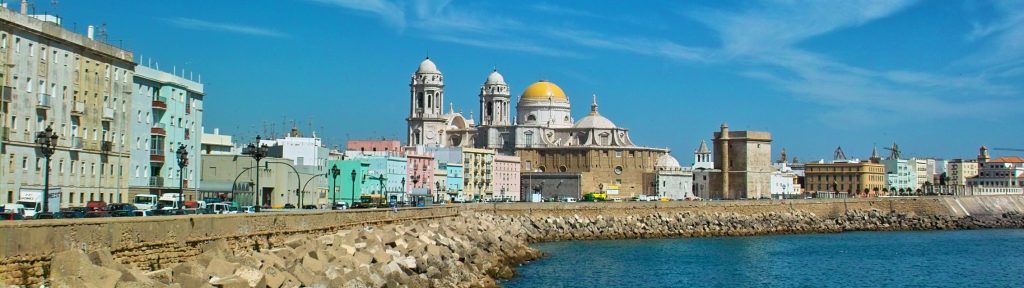
Cádiz is one of the oldest continuously inhabited cities in Western Europe, founded by Phoenician seafarers nearly 3,000 years ago on the island of Erytheia. Over time, it was shaped by Carthaginians, Romans, Byzantines, Arabs, and Castilians, each leaving their mark. In the 18th century, Cádiz became Spain’s exclusive trading port with the Americas, a role it held until 1778. Today, the Old City is a maze of narrow alleys and grand squares, dotted with over 160 towers—including Tavira Tower—and adorned with neoclassical and Isabelline architecture. Ancient remnants like the Roman Theatre, medieval gateways, and the castles of San Sebastian and Santa Catalina still stand, offering glimpses into its layered past.
How to navigate with your mobile device
JCVWalks are designed to be easy to follow on your mobile device. As you walk, you can tap the header or photo for each point of interest to open the location directly in Google Maps. This will help you navigate from your current location to the next point of interest. If you’d like to learn more about any stop along the way, just click the links in the description for additional details and context.
We will break this self guided walk up into two parts.
Cádiz Walk #1
This is the shorter of our two walks in Cádiz at approximately one mile, which is perfect for those coming off a nearby cruise ship or with limited time. Our walk begins at the Plaza de San Juan de Dios and continues to the vibrant Mercado Central, where you can enjoy enjoy some shopping and delicious tapas.

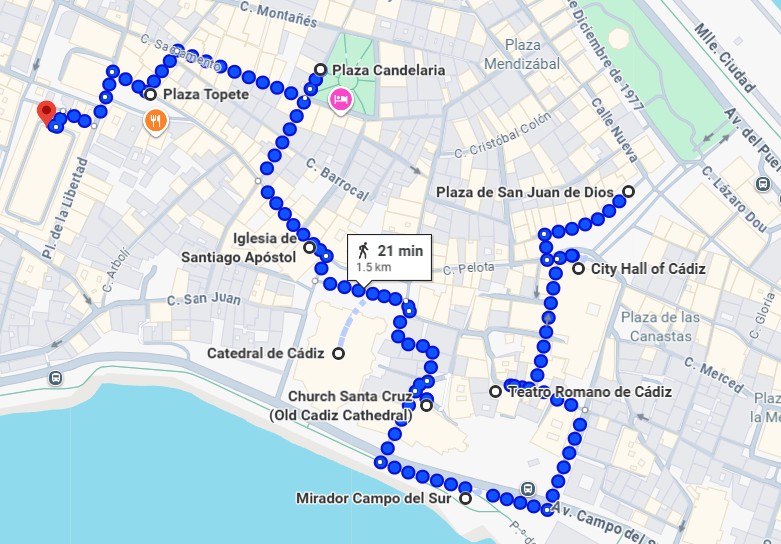
Plaza de San Juan de Dios
We will begin our walk at Plaza de San Juan de Dios, the city’s main square and a lively gathering place for centuries. In medieval times, this area sat just outside the city walls, near the old port. Access was through the sea-facing gate—today known as the Arch of the People (Arco de los Pópulos).

The square began to take shape in the 15th century, partly on land reclaimed from the sea. Over time, it grew and evolved: the city walls along the waterfront were demolished in 1906, opening up the space, and in the 18th century, the old Consistorial Houses were replaced by the grand Ayuntamiento (City Hall).
The City Hall’s façade, added in 1865 by architect Manuel García del Álamo, is a striking example of Isabelline Gothic style. Look up at the pediment—you’ll see a bas-relief of Hercules, the mythical founder of Cádiz, once called Gadeira. It’s a fitting symbol for a city that was already ancient when Hannibal passed through during the Second Punic War.
Ayuntamiento de Cadiz (Cadiz City Hall)
Standing proudly on Plaza de San Juan de Dios, the current City Hall of Cádiz dates back to 1799, built on the foundations of earlier town halls. Its design reflects two distinct phases: the original neoclassical style by architect Torcuato Benjumeda, and later Elizabethan-style interiors added by García del Álamo in 1861.
This building isn’t just about architecture—it’s also a symbol of Andalusian identity. In 1936, the Andalusian flag was raised here for the very first time, marking an important moment in regional history.
Today, Plaza de San Juan de Dios is a vibrant spot lined with cafés and restaurants, perfect for relaxing after your walk. It’s the ideal place to soak up the atmosphere of Cádiz—where history, architecture, and daily life all come together.

Teatro Romano
Hidden in the El Pópulo district, the Roman Theatre of Cádiz (also called Teatro Balbi) is one of the city’s most remarkable archaeological finds. Built around 70 BC, it was rediscovered in 1980 during construction work and is still only partially uncovered.

The theater was commissioned by Lucius Cornelius Balbus the Elder, a native of Cádiz and a close ally of Julius Caesar. Balbus and his family dreamed of expanding ancient Gades into a “New City” (Neapolis), and this grand theater was part of that vision.
What makes it special? It’s considered the oldest—and possibly the largest—Roman theater in Spain, with seating for up to 10,000 spectators. Its design features a horseshoe-shaped auditorium, tiered seating, and a distribution gallery beneath, supported by barrel vaults. The outer walls were built from finely cut ashlar stone, a testament to Roman engineering.
Today, you can explore the site through a modern interpretation center, complete with exhibits and glass floors revealing the ruins below. And the best part? Admission is free, making this an easy and fascinating stop on your walk through Cádiz’s history.
Mirador Campo del Sur
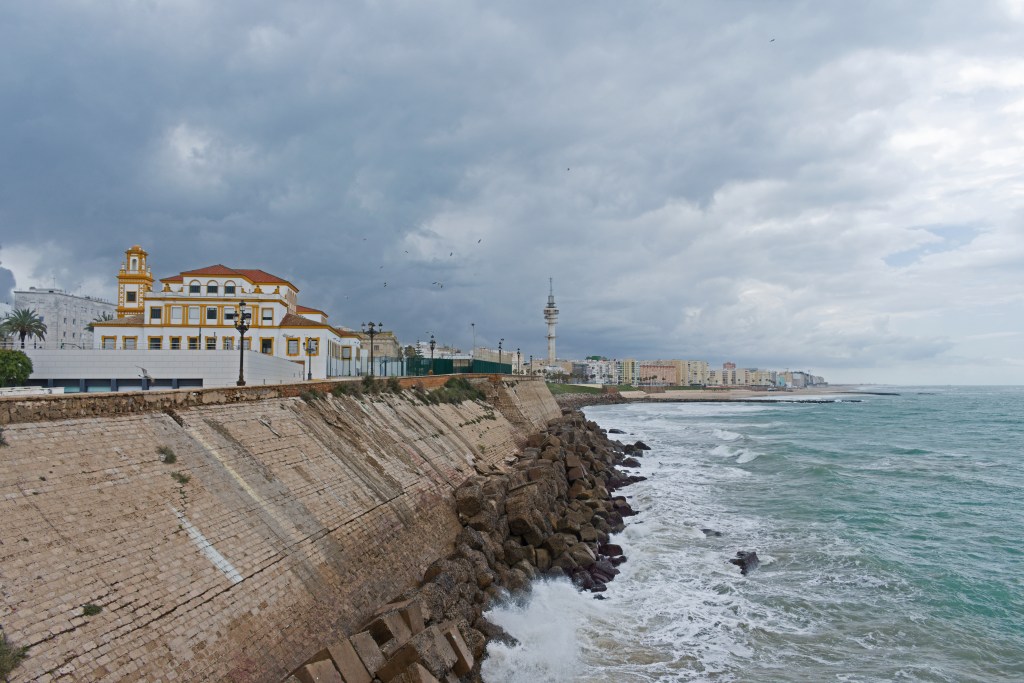
Just a short stroll from the Roman Theatre, the Mirador Campo del Sur offers one of the most iconic coastal views in Cádiz. Perched along the city’s southern waterfront, this scenic overlook stretches beside the sea wall, with panoramic vistas of the Atlantic Ocean and the dramatic curve of the coastline.
From here, you’ll see the golden dome of the Cádiz Cathedral rising above the rooftops, framed by the turquoise waters and the palm-lined promenade. It’s a perfect spot to pause, take in the sea breeze, and snap a few photos. The mirador also gives you a sense of Cádiz’s maritime soul—fishing boats bob in the harbor, and locals gather along the wall to chat, fish, or simply enjoy the view.
Whether you linger for a few minutes or take a seat on one of the benches, this peaceful viewpoint offers a refreshing contrast to the ancient stones of El Pópulo.
Cathedral of Santa Cruz
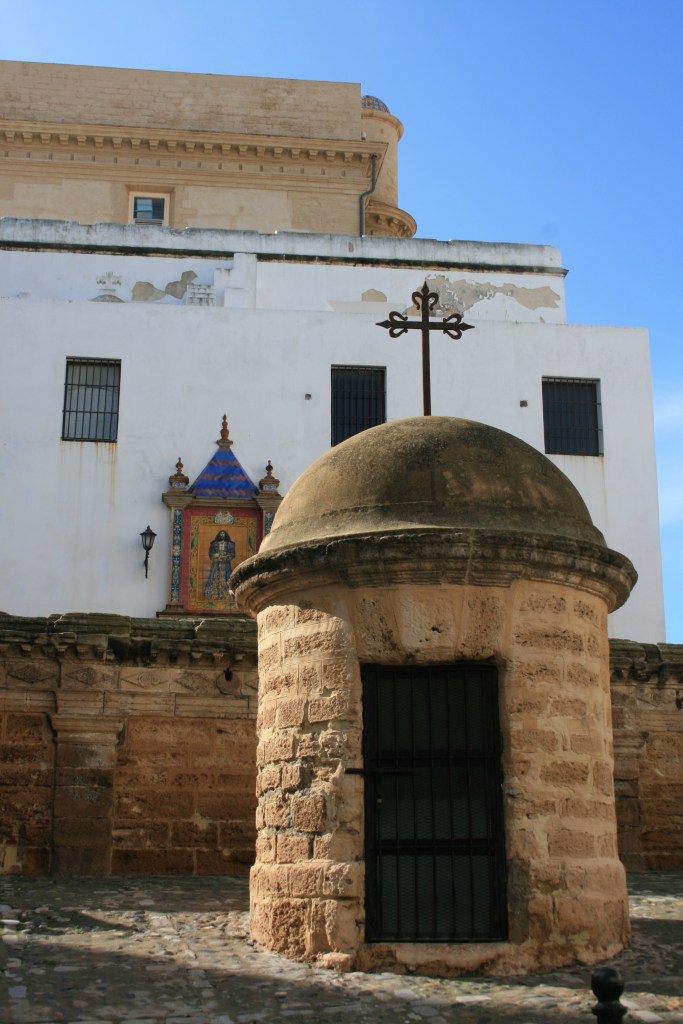
As we walk back into town towards Cathedral Square, we will pass the Old Cathedral (Santa Cruz). Its story goes way back—it was first built in 1262, after King Alfonso X reclaimed the city. That original structure didn’t survive, though; in 1596, an Anglo-Dutch fleet led by Admiral Edward Howard sacked Cádiz and burned the church to the ground. What you see today was rebuilt by 1602.
Don’t miss the Arco de la Rosa, an old gateway that once led to the Town Castle and the former Plaza de las Tablas, now transformed into this grand square. If you can, please revisit this spot after dark. The lighting on the cathedral is beautiful!
Cadiz Cathedral and Square
The 18th century was Cádiz’s golden era, fueled by wealth from trade with the Americas. To showcase its prosperity, the city set out to build a cathedral that would rival—and even surpass—the grandeur of Seville’s. Architect Vicente de Acero, who also designed Granada Cathedral, began the project, but after a dispute in 1739, he walked away, leaving others to complete the work over the next century.
The cathedral follows a Latin cross plan with three naves and a pentagonal ambulatory. Rows of Corinthian columns support the soaring vaults, and the altar sits elevated above a spacious crypt. Chapels line the naves, and in the choir, you’ll find two magnificent organs that are true treasures.
One of the highlights is the Clock Tower, also called the Levante Tower, which rises 184 feet. Climb to the top for sweeping views of the El Pópulo district, the ocean, the Campo del Sur promenade, and the harbor—a panorama worth the effort.
The cathedral dominates Plaza de la Catedral, a square created during an urban reform in 1721 that cleared space for this monumental project. The square isn’t perfectly symmetrical; it runs parallel to the seafront and is paved in white marble.

Iglesia de Santiago
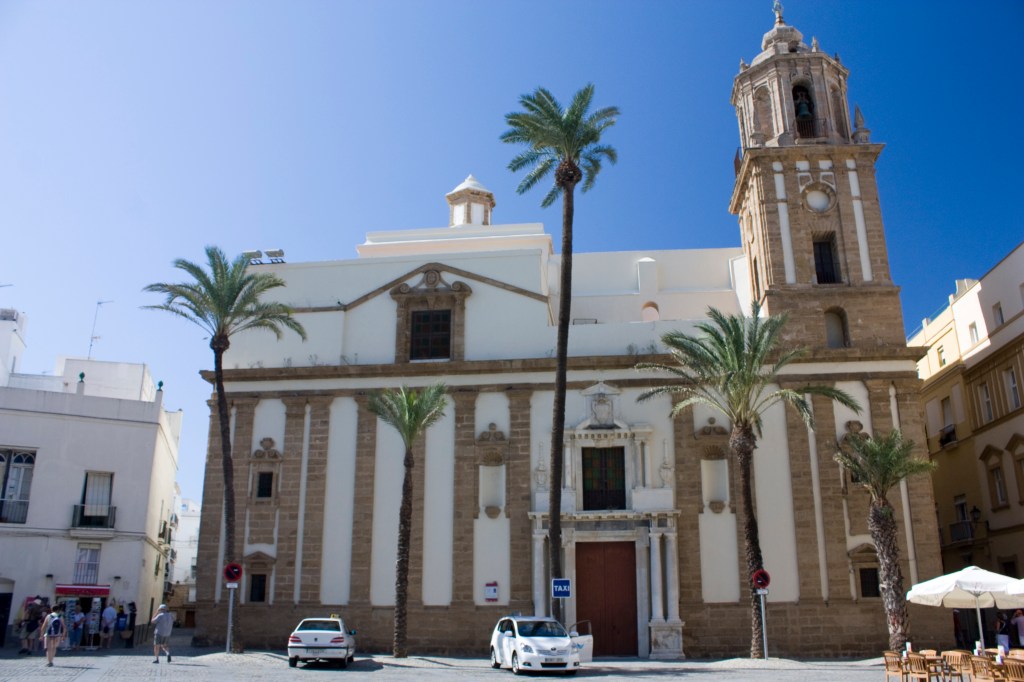
Our next stop is the Church of Santiago, a striking example of Mannerist architecture dating back to 1635. Originally part of a Jesuit college founded in the mid-1500s, the church is all that remains of the complex today. It was designed by Alonso Romero and served as the spiritual heart of the Jesuit school.
The main façade faces Plaza de la Catedral and is framed by 14 paired Ionic pilasters made from Cádiz’s signature oyster stone. The church has two beautiful marble portals in the Mannerist style: one on the main façade, imported from Genoa and set within a large semicircular arch, and another along Calle de Santiago, added in the mid-17th century.
Where the two façades meet, a tower rises in two stages. The lower section mirrors the pilasters of the main façade, while the upper section—added in the 18th century—features an octagonal plan topped with a distinctive bulbous dome in Baroque style. It’s a fascinating blend of architectural periods that reflects Cádiz’s layered history.
Plaza de la Candelaria
Tucked away in the historic center, Plaza de la Candelaria is one of Cádiz’s oldest squares—and one of its most charming. Its trapezoid shape gives it a unique layout, and the greenery adds to its appeal. The outer edge is lined with tall elms (some now being replaced by hackberry trees), while the inner rows of bitter orange trees fill the air with the sweet scent of blossoms in spring.
The buildings around the square mostly date from the late 19th century and showcase the elegance of the Romantic era. Look for house number 15, known as the Asilo de Oviedo, with its Elizabethan-style details—pilasters and corbels adorned with eagle figures. Another standout is number 6, built in 1906, which combines glass and iron for a striking architectural contrast.
At the center of the square stands a bronze statue of Emilio Castelar, a celebrated orator, journalist, and historian who served as the last president of Spain’s First Republic. Sculpted by Eduardo Barrón in 1906, it’s a fitting tribute in a square that feels steeped in history.
Plaza Topete
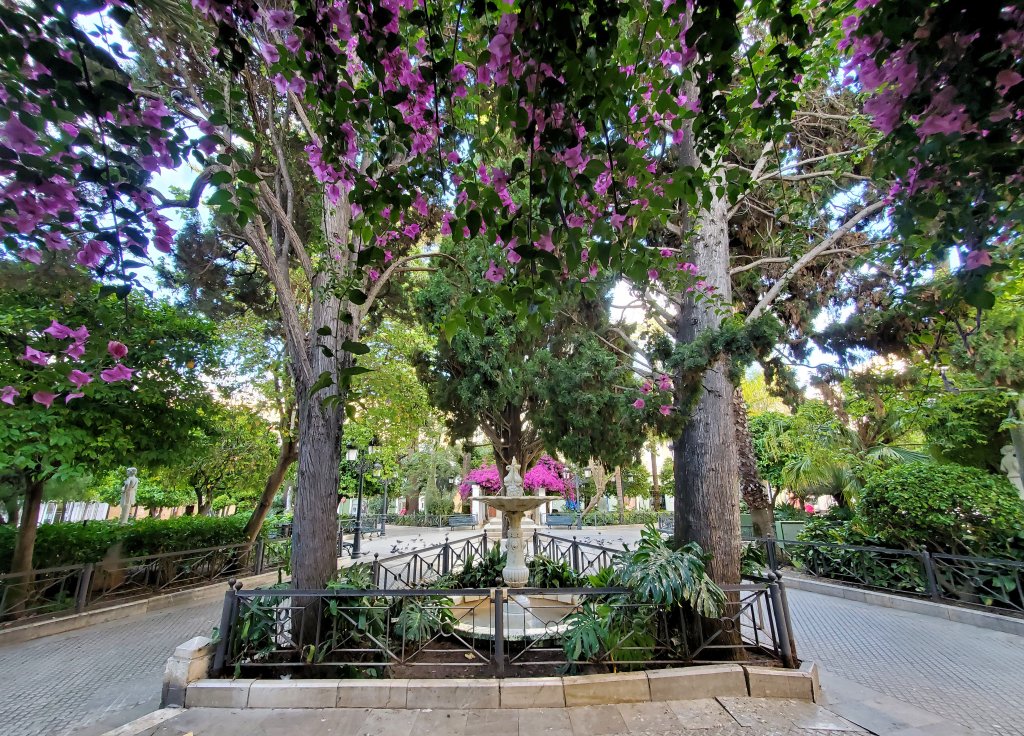
Just a few steps away lies our next stop is Plaza Topete, informally known as the Plaza de las Flores, one of Cádiz’s most colorful and lively squares.True to its name, the plaza is filled with fragrant flower stalls that bring a burst of color and charm to the area. During Carnival, the square becomes even more animated, with street performances and music spilling over from nearby Plaza de la Libertad.

But Plaza de las Flores isn’t just about flowers—it’s steeped in history and surrounded by striking architecture. The site once housed the Convent of the Shoeless, and in 1930, it welcomed the Post Office and Telegraph Building, a beautiful example of eclectic regionalist style with glazed ceramic details that contrast with the more traditional Cádiz façades.
As you explore, look out for building number 1, dating back to 1746, with its classic Cádiz Baroque façade framed by pilasters. Another standout is number 12, a neoclassical gem by architect Torcuato Benjumeda, featuring giant Doric pilasters that give it a bold, elegant presence.
Central Market
No walk through Cádiz is complete without a stop at the Mercado Central, the city’s main market and a feast for the senses. As part one of our walk ends, this lively hub offers a perfect spot to pause and recharge. Grab a seat at one of the bustling stalls or counters and enjoy a few classic bites—perhaps tortillitas de camarones (shrimp fritters), jamón ibérico, or a refreshing salmorejo. It’s a great way to soak in the local flavor and energy before continuing your journey.
The market is alive with more than 170 stalls selling everything from fresh fish and seafood to fruits, vegetables, meats, baked goods, and more. The central pavilion is where the seafood action happens—expect to see an incredible variety of fish straight from the Atlantic. On the left wing, you’ll find the Rincón Gastronómico, a foodie’s paradise offering tapas, sushi, cheeses, and even craft beer. On the right wing, meats and unusual produce await, along with the Gourmet Corner, a highlight for anyone who loves artisanal flavors.
The Mercado Central stands on the site of the old farmers’ market and took its current form in the late 1800s, thanks to architect Torcuato Benjumeda—the same mind behind the Town Hall and the Church of San José. His design? An open-air quadrangle framed by elegant Doric-style columns.

Cadiz Walk #2
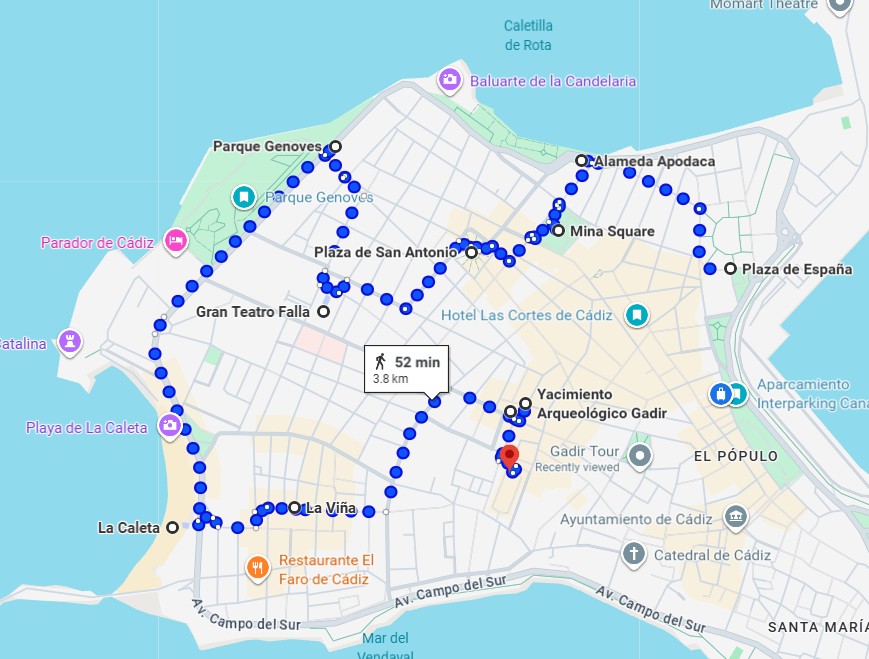
The second walk will take us from the Plaza de España to the Mercado Central, or the Cádiz Central Market. This walk is 3.6 km or just over 2 miles. It is mostly flat.
As you walk, you can click the header or photo which will open up the destination in google maps. You can use this to help you navigate from your current location to the next destination. If you want to learn more about each point of interest, you can click the links in the description.

How to navigate with your mobile device
JCVWalks are designed to be easy to follow on your mobile device. As you walk, you can tap the header or photo for each point of interest to open the location directly in Google Maps. This will help you navigate from your current location to the next point of interest. If you’d like to learn more about any stop along the way, just click the links in the description for additional details and context.
Plaza de España
We’re kicking off our walk at one of Cádiz’s most impressive squares—Plaza de España. It’s a great place to gather your group, with plenty of open space, shady spots, and some incredible architecture to take in.
Right in the center, you’ll see the striking white monument dedicated to the Spanish Constitution of 1812, a big moment in the country’s history. The design is full of symbolism—bronze horsemen representing war and peace, and a statue of Hercules, a nod to Cádiz’s legendary roots.
Before we head out, take a quick look around the square. On one side, you’ll spot the Customs Palace, a neoclassical beauty that now houses the provincial government. Nearby is the House of the Five Towers, a row of 18th-century homes linked together, each with its own little lookout tower—a perfect example of Cádiz’s blend of Baroque and Neoclassical styles. And if you glance north, you’ll see the San Carlos neighborhood, lined with elegant façades that tell the story of the city’s golden age.
Once you’ve soaked it all in, we’ll start walking from here and dive deeper into Cádiz’s charm.

Alameda Apodaca Promenade
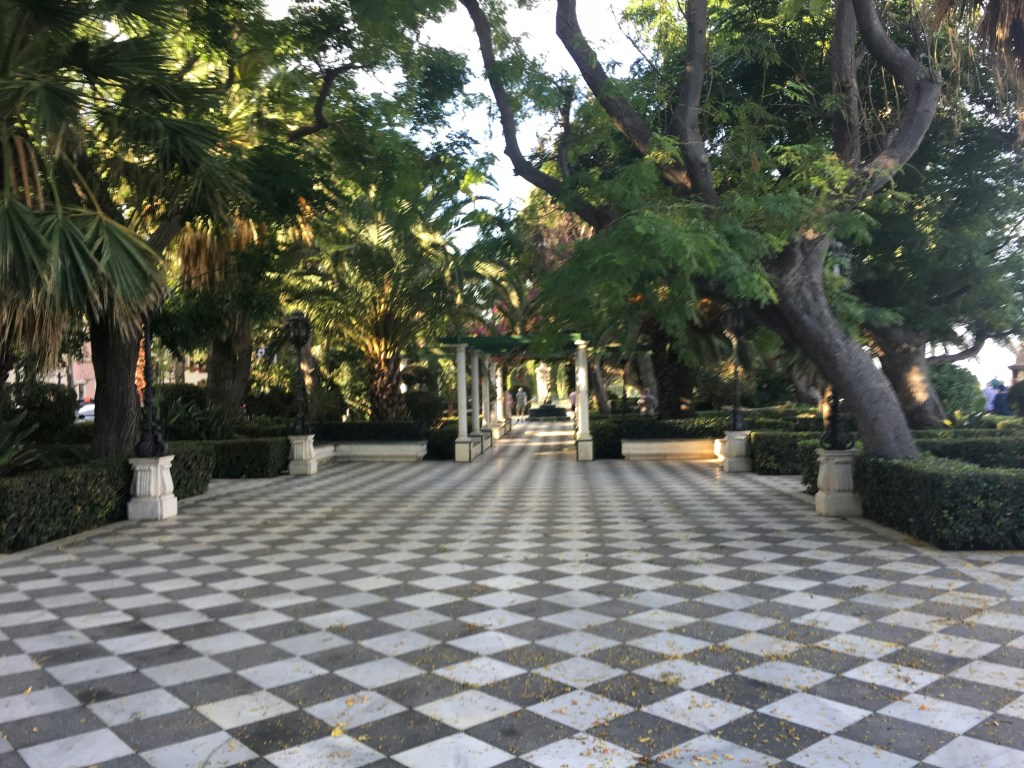
Next, head to the Alameda Apodaca Promenade. This landscaped walkway runs parallel to the sea and the city wall. It was designed in the regionalist style between 1926 and 1927 by architect Juan Talavera y Heredia. The promenade offers beautiful views of the bay and is a popular spot for both locals and visitors.
Plaza de Mina
Our next stop is Plaza de Mina, a leafy square right in the center of Cádiz’s historic district. It’s been a favorite gathering spot for locals for generations, and it’s easy to see why—shaded paths, benches, and a calm atmosphere make it a perfect place to slow down for a few minutes.
The square dates back to the mid-19th century, when the land—once owned by the Catholic Church—was transformed into a public space. It originally featured a monument to war hero Espoz y Mina, but later renovations changed the layout, and the statue is no longer here.
Take a stroll around the edges of the square and notice the elegant buildings that frame it. One highlight is the birthplace of composer Manuel de Falla, marked by a simple plaque. On the eastern side, you’ll find the Museum of Cádiz, which is worth a visit if you have time. Inside, you’ll discover collections of fine art, ethnography, and archaeology—the Phoenician sarcophagi are the real showstopper.

Plaza de San Antonio
San Antonio Square (Plaza de San Antonio), located in Cádiz, is a significant and historic square that serves as one of the city’s nerve centers. Originally called Field of Rockrose (Campo de Jara), it gained its current name in the mid-17th century when the hermitage dedicated to San Antonio was constructed. The well of the same name, which had supplied the city with drinking water for many years, is situated close by.

During the 18th century, the square underwent a significant urban expansion and became a hub for commercial and religious activities, integrating the current Saint John of God Square (Plaza de San Juan de Dios). It is notable for being the site where the Constitution of 1812 was proclaimed and for being the location of the brutal suppression of the liberal movement of 1820.
The buildings that encircle San Antonio Square are of great interest, showcasing an impressive uniformity of proportions, save for the slender façade of the Church of Sant’Antonio. The Casino Gaditano, built in the 18th century, is a Baroque-style building that underwent a renovation in the Elizabethan style in 1857. Its patio and rooms feature rich Neo-Mudejar decorations created by the Sevillian artist Adolfo Lopez Rodriguez in 1890.
Gran Teatro Falla
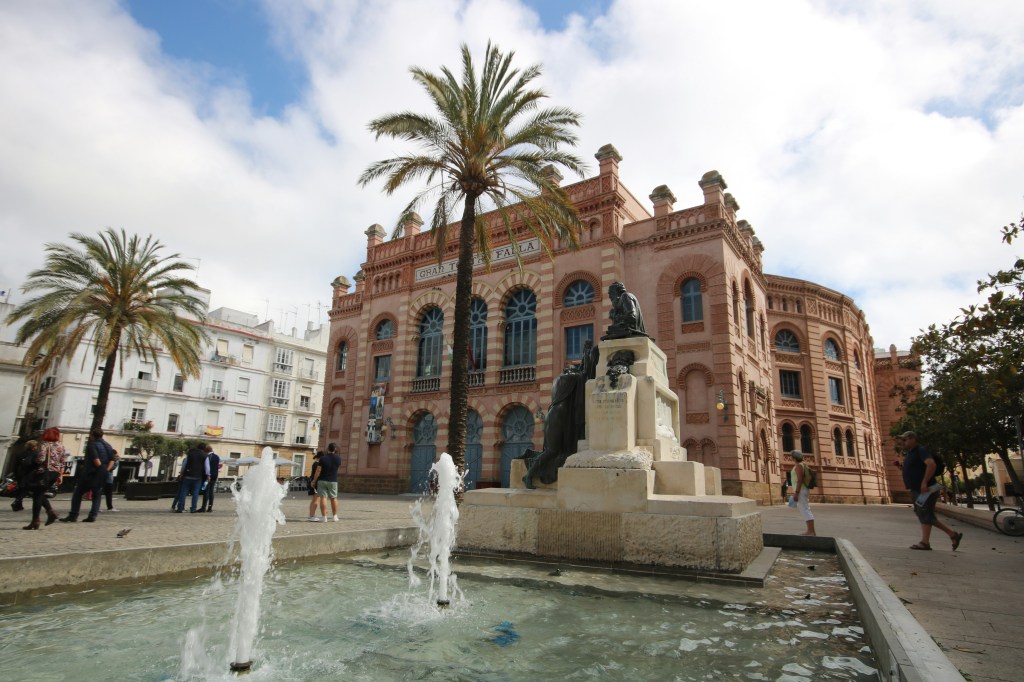
Our walk brings us to the Gran Teatro Falla, one of Cádiz’s most recognizable landmarks. It wasn’t always called that—when it opened in 1905, it was simply the Great Theater. The name changed in 1926 to honor composer Manuel de Falla, who was at the height of his fame at the time.
The theater we see today replaced an earlier wooden structure that burned down in 1881. Architect Juan Cabrera de la Torre gave the new building a bold Neo-Mudéjar design, and it’s hard to miss those three massive horseshoe arches at the entrance, with their striking red-and-white pattern.
Step inside (if you can!) and you’ll find elegant staircases leading up to U-shaped galleries. The stage is huge—59 feet wide and 84 feet deep—and the ceiling is a work of art in itself, featuring an allegory of Paradise painted by Felipe Arbazuza y Rodríguez de Arias.
Parque Genoves
Next, we will visit Parque Genovés, the largest green space in Cádiz’s Old Town. Covering about 30,000 square meters, this park has been a favorite escape since it opened in 1892. Before that, the area was known as the Walk of Parsley—a pretty bare stretch of land between military barracks and the sea wall. Hard to imagine now, given how lush it is today!
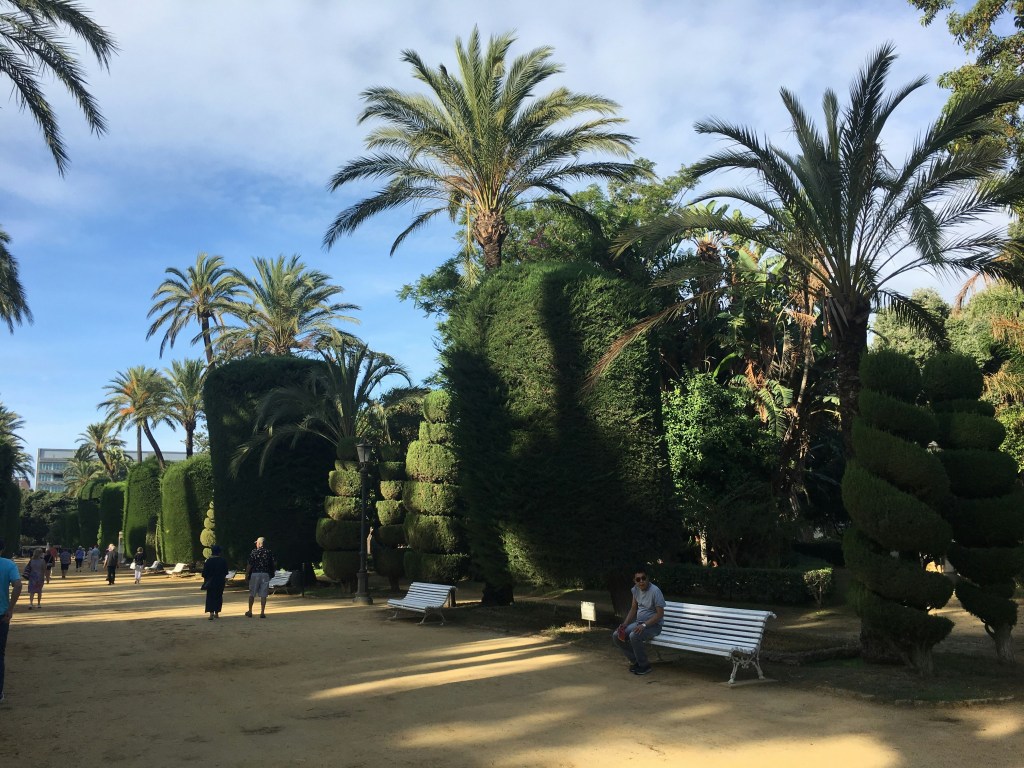
The park is almost trapezoid in shape, and if you enter through Plaza Rocío Jurado, you’ll find yourself on a wide avenue lined with double rows of flowerbeds. These beds frame oyster-stone fountains, all set among tall cypress trees and graceful date palms.
What makes this park special is its incredible variety of plants—over 150 species of exotic trees, palms, and shrubs. Keep an eye out for some real standouts: the Canary Islands dragon tree, the New Zealand pohutukawa, and the quirky Monkey Puzzle Tree from South America.
As you wander, you’ll come across a pond, a small waterfall, and even a little cave. Scattered throughout are sculptures and fountains, including the charming “Children Under the Umbrella”. Other monuments pay tribute to notable figures like botanist José Celestino Mutis, poet José María Pemán, composer Manuel de Falla, and naturalist Félix Rodríguez de la Fuente—plus one commemorating the Battle of Trafalgar.
Playa de La Caleta

Playa La Caleta, is the city’s most iconic beach. It’s small but full of character, and it regularly earns the Blue Flag for its clean waters and great facilities.
La Caleta sits between two historic fortresses: Castillo de Santa Catalina and Castillo de San Sebastián. Both are worth a look, but the real eye-catcher is the elegant white building stretching over the sand—the Balneario de Nuestra Señora de la Palma y del Real. Built in the early 1900s, this former spa is now home to the Underwater Archaeology Center of the Andalusian Historical Institute.
This beach has deep roots in Cádiz’s history. In ancient times, it was the natural harbor that connected the two islands of old Gades. The Phoenicians landed their ships here, and archaeologists have uncovered incredible finds beneath its sands—many more likely remain hidden. In a way, this is where Cádiz began.
And if it feels familiar, you might have seen it on screen. La Caleta has appeared in films like Alatriste, Manolete, and even James Bond’s Die Another Day. That famous scene of Halle Berry walking out of the water? Filmed right here—though in the movie, it’s supposed to be Havana!
Across the water, about 3,700 miles away to the west is Washington DC. Playa La Caleta is a lively spot, especially at sunset, so take a moment to enjoy the view before we move on to our next stop.
La Vina
Next, we wander into La Viña, one of the most traditional neighborhoods in Cádiz’s historic center. Its name—“The Vine”—hints at its past, when this area was covered in vineyards before the city expanded.
By the 18th century, Cádiz was booming thanks to trade with the Americas, and La Viña began to fill with homes. Because it sat farther from the port, it didn’t attract wealthy merchants or shipowners. Instead, it became a working-class neighborhood, home to fishermen who relied on nearby La Caleta Beach for their livelihood.
Today, La Viña is known for its lively, down-to-earth vibe. Narrow streets, colorful façades, and plenty of tapas bars make it a favorite spot for locals—and during Carnival, this is the heart of the party.
Torre Tavira
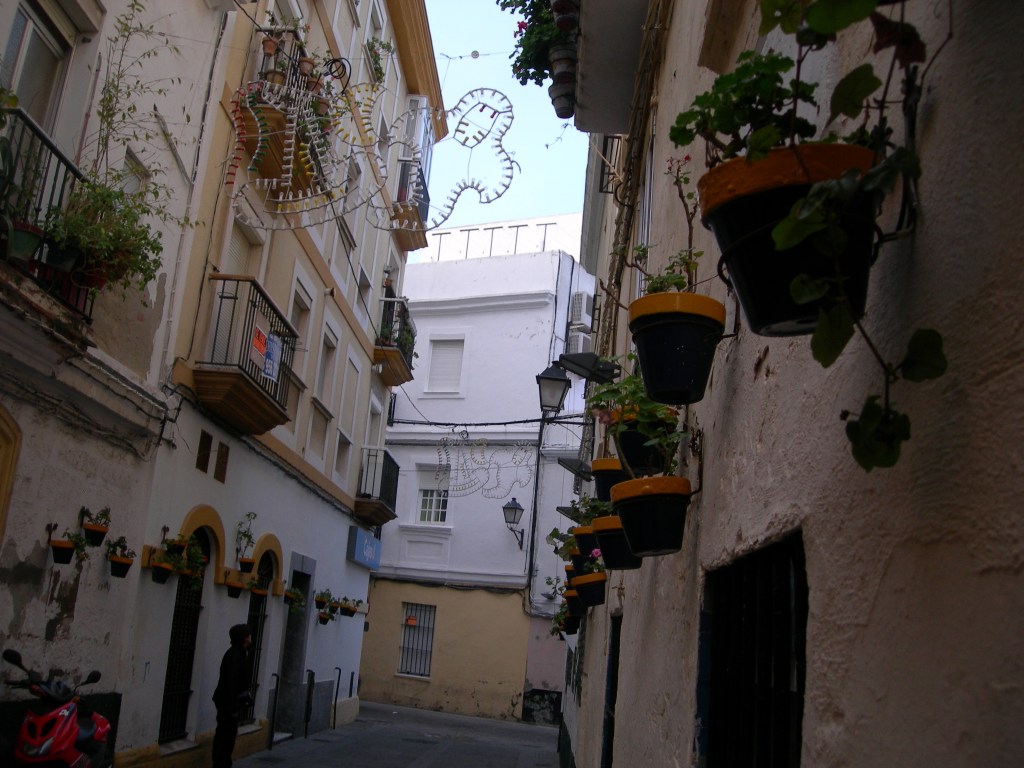
Now we head to Torre Tavira, the highest point in Cádiz’s Old Town and the city’s official watchtower. Rising more than 149 feet above sea level, it offers unbeatable views of the rooftops and the sparkling bay beyond.

The tower is part of the Casa Palacio de los Marqueses de Recaño, which today houses the Cádiz Conservatory of Music. Back in the 18th century, when Cádiz was booming as Spain’s gateway to trade with the Americas, the city built over 120 watchtowers to keep an eye on incoming ships. Torre Tavira, built in 1780, was the tallest—and the most important.
Its first watchman, Don Antonio Tavira, gave the tower its name. Inside, you’ll find something special: a Camera Obscura, a fascinating optical device that projects live images of the city onto a viewing surface. It’s a unique way to see Cádiz from a whole new perspective.
Gadir Archaeological Site
Cádiz isn’t just old—it’s ancient. By the time Hannibal launched the Second Punic War, this city was already 700 years old! Around 1,000 BC, the Phoenicians settled on two small islands, Erytheia and Kotinoussa, in the Guadalete River and founded a port they called Gadir—the earliest version of Cádiz. It became part of the Phoenician trade network around the Strait of Gibraltar, a key link in their Mediterranean empire.
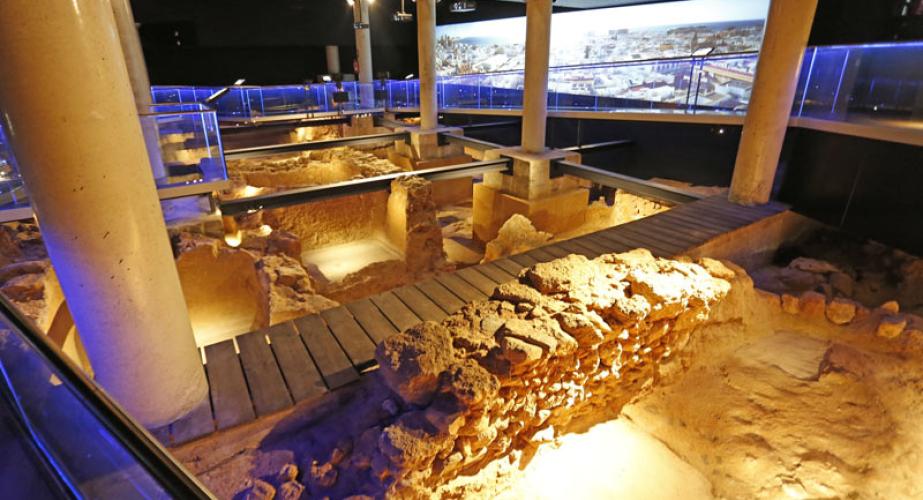
Fast forward a few millennia, and you can still step into that world at the Gadir Archaeological Site. Discovered during the restoration of the Títere Norica Puppet Theatre, the site opened to the public in 2014 and is now one of Cádiz’s most fascinating attractions. It sits on the highest point of ancient Erytheia, the smallest of the original islands.
Here, you’ll see the remains of Phoenician streets, homes, and even traces of daily life from nearly 3,000 years ago. And the best part? It’s free to visit—but there’s a catch: depending on the time of year, you may need to book a timed entry ticket in person at the site (no online or phone reservations), so it’s smart to go early and secure your spot for the day.
Mercado Central (Central Market)
No walk through Cádiz is complete without a stop at the Mercado Central, the city’s main market and a feast for the senses. As part one of our walk ends, this lively hub offers a perfect spot to pause and recharge. Grab a seat at one of the bustling stalls or counters and enjoy a few classic bites—perhaps tortillitas de camarones (shrimp fritters), jamón ibérico, or a refreshing salmorejo. It’s a great way to soak in the local flavor and energy before continuing your journey.

The market is alive with more than 170 stalls selling everything from fresh fish and seafood to fruits, vegetables, meats, baked goods, and more. The central pavilion is where the seafood action happens—expect to see an incredible variety of fish straight from the Atlantic. On the left wing, you’ll find the Rincón Gastronómico, a foodie’s paradise offering tapas, sushi, cheeses, and even craft beer. On the right wing, meats and unusual produce await, along with the Gourmet Corner, a highlight for anyone who loves artisanal flavors.
The Mercado Central stands on the site of the old farmers’ market and took its current form in the late 1800s, thanks to architect Torcuato Benjumeda—the same mind behind the Town Hall and the Church of San José. His design? An open-air quadrangle framed by elegant Doric-style columns.
Thanks for walking with me
I hope you’ve enjoyed this journey through Cádiz—a city that feels like a living museum, where every square, street, and sea view tells a story. From its Phoenician roots to its golden age of trade, Cádiz has a way of blending history, culture, and everyday life like nowhere else. It’s a place that rewards slow exploration and a curious eye.
If you enjoyed the route, found a hidden gem, or have ideas for improving the experience, I’d love to hear from you! Your insights help me improve future walks and inspire fellow travelers. Please rate this walk using the stars below — and feel free to leave a comment. Gracias! — and happy exploring!
Thanks for your feedback!

Photo Credits
- Cadiz – Photo By Dicklyon – licensed under CC BY-SA 4.0, source
- Cadiz_Plaza_de_San_Juan_de_Dios – Soulndr CC by SA 3.0
- City Hall – Photo by Josh Gauthier- unsplash
- Teatro Romano – Photo by By Peejayem – Own work, CC BY-SA 3.0, source
- Mirador Campo del Sur – Photo By Ymblanter – licensed under CC BY-SA 4.0, source
- Cathedral of Santa Cruz – Photo by Olbertz 17:57, 10. Dez. 2010 (CET) – Licensed under, CC BY-SA 3.0, source
- Cadiz Cathedral 02 – Photo by Tango7174 – Own work, CC BY-SA 4.0, Source
- Cádiz Iglesia Santiago Apóstol – Photo by Daniel Villafruela, License CC BY-SA 4.0. Source
- Plaza De La Candelaria (Cádiz) – Photo by Jmpuyana, Trabajo propio, License CC BY-SA 4.0. Source
- Plaza Topete (Flores) Cádiz – Photo by Pedro M. Martínez Corada – licensed under CC BY 3.0, source
- Cadiz Central Market 01 – Photo by Ayuntemiento de Cadiz Tourism, source
- Plaza de España – Photo by getty-images for unsplash
- Alameda Apodaca Promenade – Photo by Josh Gauthier unsplash
- Plaza de Mina – Photo by Banja-Frans Mulder, licensed under CC BY 3.0
- Plaza de San Antonio De Padua – Photo by Hombre D Hojalata from Spain, License CC BY-SA 2.0. Source
- Gran Teatro Falla – Photo by Jorge Fernandez Salas unsplash
- Parque Genoves – Photo by Josh Gauthier unsplash
- La Caleta Cádiz – Photo by Emilio J. Rodríguez Posada – licensed under CC BY-SA 2.5, source
- Barrio de la Viña – Photo by Chemasanco – licensed under CC BY 2.0, source
- Torre Tavira – Photo by academia.andaluza, source
- Cadiz Central Market – Photo by Banja-Frans Mulder, CC BY 3.0, Source
