Madrid’s Cultural Heart: Art, Gardens, and Quiet Beauty

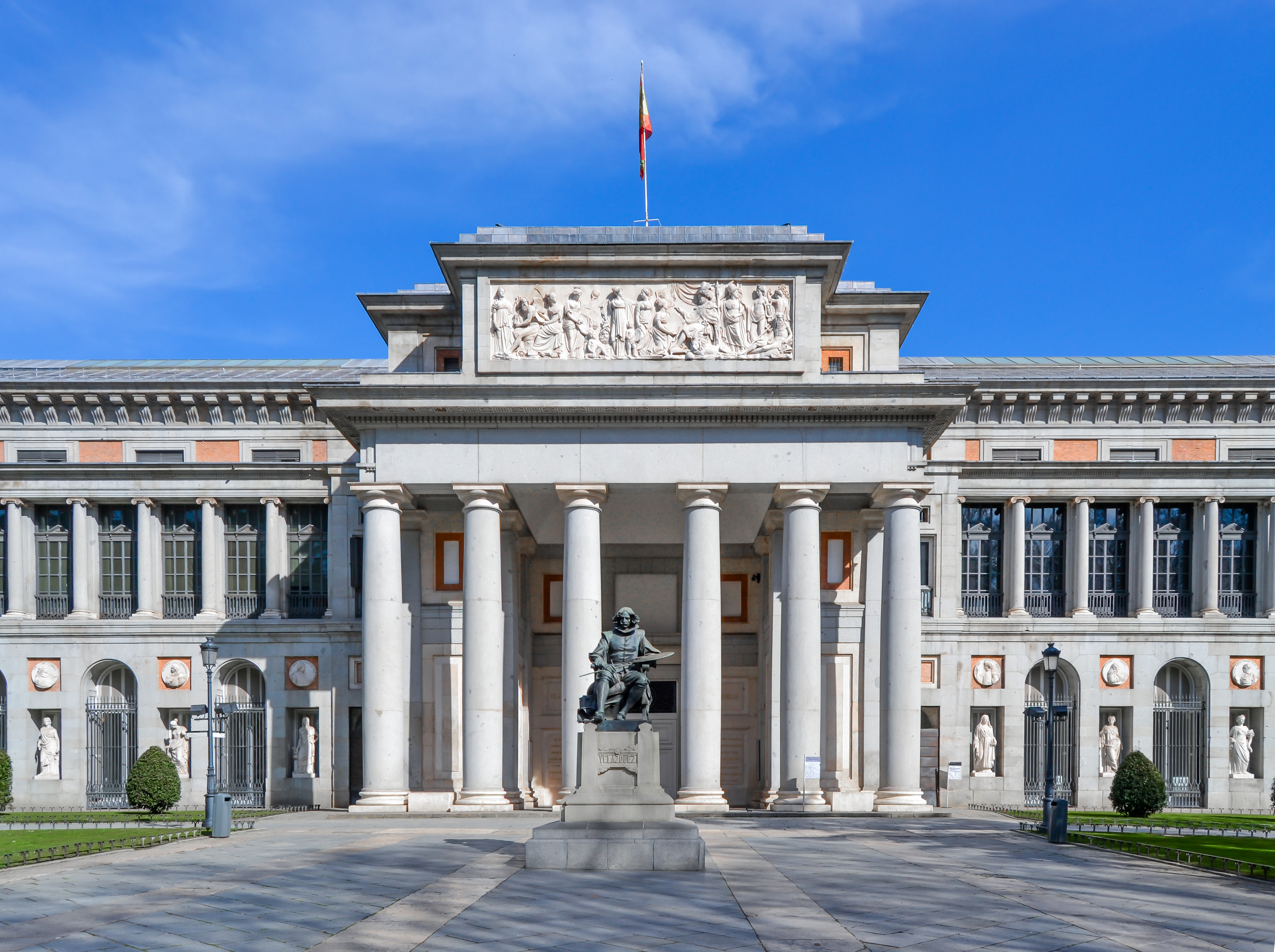

This walk focuses on one of Madrid’s most beloved areas: the cultural and natural heart surrounding Retiro Park. Over the course of 5.7 km (3.5 miles), we’ll explore elegant gardens, historic exhibition halls, world-class museums, and even a rooftop bar with sweeping views. Along the way, you’ll encounter the city’s artistic legacy—from the classical masterpieces of the Prado to the modern provocations of Reina Sofía—as well as quiet corners of scientific curiosity and local flavor. Each stop offers a glimpse into Madrid’s layered identity, blending royal history, creative energy, and the simple pleasures of daily life.

How to Navigate with your Mobile Device
JCVWalks are designed to be easy to follow on your mobile device. As you walk, you can tap the header or photo for each point of interest to open the location directly in Google Maps. This will help you navigate from your current location to the next point of interest. If you’d like to learn more about any stop along the way, just click the links in the description for additional details and context.
Puerta de Alcalá
We begin at one of Madrid’s most iconic landmarks. Built in 1778 under King Carlos III, this neoclassical gate once marked the eastern entrance to the city. It predates both the Arc de Triomphe and Brandenburg Gate, and its elegant arches are a symbol of Madrid’s imperial past. It’s a great spot to orient ourselves before heading into Retiro Park.


Parque del Buen Retiro
Just across the street, we enter Parque del Buen Retiro, (Retiro Park) once the private playground of Spanish royalty. Created in the 17th century, it became public in the late 1800s. As we walk past the Retiro Pond, you’ll see locals rowing boats and relaxing by the water. The grand monument to Alfonso XII overlooks the lake, offering a peaceful place to sit and people-watch.
Palacio de Cristal (Crystal Palace)
Nestled in the heart of the park, this glass-and-iron structure was built in 1887 to showcase flora from the Philippines. Today, the Glass Palace hosts contemporary art exhibitions curated by the Reina Sofía Museum. The building itself is a marvel—light dances through the glass, and the surrounding pond reflects its beauty. It’s a serene, almost magical spot. Admission is free, and it’s typically open during park hours.

Palacio de Velázquez
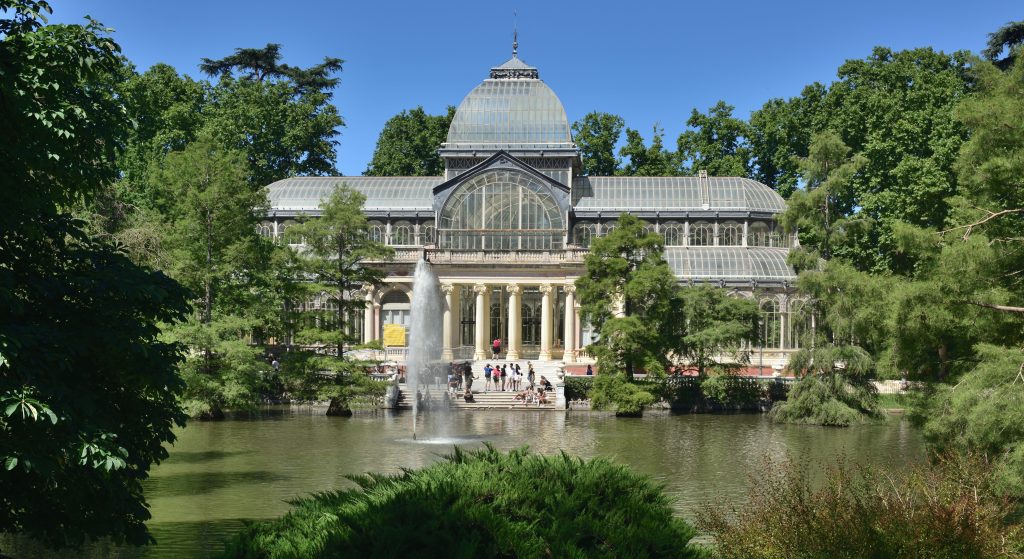
A short walk away, this elegant red-brick building was constructed in 1884 for the National Exhibition of Mining. Like the Crystal Palace, the Palacio de Velázquez now hosts temporary art exhibits. It’s quieter and less crowded, offering a more intimate experience with modern Spanish art. Also managed by Reina Sofía, admission is free, and it’s open daily except Tuesdays.
Royal Observatory of Madrid
We exit the park briefly and head southeast to the Real Observatorio de Madrid, founded in 1790 by King Carlos III. Designed by Juan de Villanueva (who also designed the Prado), it played a key role in Spain’s scientific development. The observatory houses antique telescopes and instruments.
- Admission: Adults €5, Reduced €3, Children under 10 free
Tours last about 1.5 hours and include access to historic instruments and exhibits. - Hours: Open mainly on weekends via guided tours (advance reservation required)

El Museo de la Reina Sofía
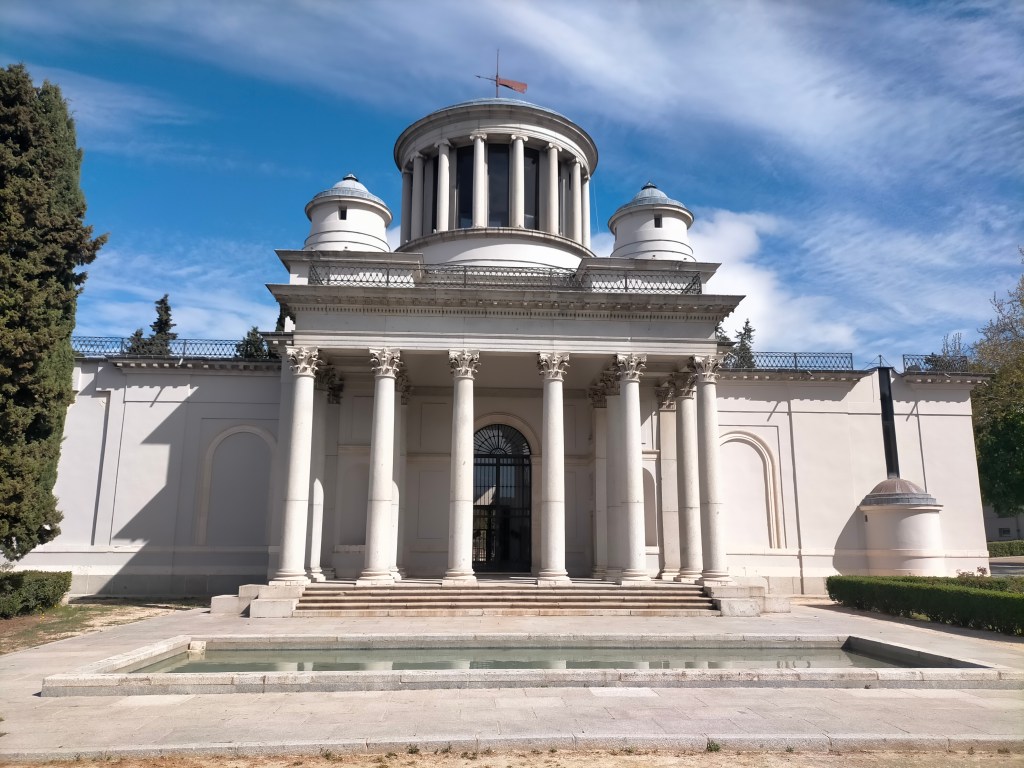
A short walk south brings us to the Museo Reina Sofía, Spain’s national museum of 20th-century art. Housed in a former hospital, it blends classical architecture with modern glass towers. The highlight here is Picasso’s Guernica, a haunting anti-war masterpiece. The museum also features works by Dalí and Miró.
- Art Walk Pass: €32.80 (shared with Prado and Thyssen)
- Hours: Mon & Wed–Sat 10 AM–9 PM, Sun 10 AM–2:30 PM, Closed Tuesdays
- Admission: General €12, Two visits €18, Free for eligible groups
- Free Entry: Mon & Wed–Sat 7–9 PM, Sun 12:30–2:30 PM
El Museo del Prado
El Prado, Spain’s national art museum, is a must-visit. With a collection of 7,600 paintings and 1,000 sculptures, you could easily spend hours here. You can either buy a skip-the-line ticket and explore at your own pace or join a guided tour with an art expert.


El Cielo de Alcalá Rooftop Bar
To wrap up our walk, we return to the edge of Retiro Park and ascend to the rooftop of the H10 Puerta de Alcalá Hotel. El Cielo de Alcalá offers panoramic views of the park and city skyline. Sip a spritz or a vermouth, nibble on Mediterranean tapas, and soak in the golden hour light. It’s a relaxed, elegant way to end the day.
- Hours: Open daily from late afternoon to midnight (weather permitting)
- Pricing: Cocktails around €10–14, tapas €8–15
Thank you for walking with me!
Thanks for joining me on this walk through one of Madrid’s most beautiful and culturally rich neighborhoods. I hope it gave you a deeper feel for the city—its art, its history, and its everyday rhythm.
If you enjoyed the route, found a hidden gem, or have ideas for improving the experience, I’d love to hear from you! Your insights help me improve future walks and inspire fellow travelers. Please rate this walk using the stars below — and feel free to leave a comment. Gracias! — and happy exploring!
Thanks for your feedback!

Photo Credits
- Retiro Park – Photo by Getting images on unsplash
- Prada Museum Gallery – Photo by Angel de los Rios from Valladolid, Spain, CC BY-SA 2.0, source
- Retiro Park Fountain – Photo by Dmitry Dzhus from London, CC BY 2.0, source
- Puerta de Alcala Gate – Photo by Ank Kumar – licensed under CC BY-SA 4.0, source
- Monument to Alfonso XII of Spain – Photo by Carlos Delgado, licensed under CC BY-SA 3.0, source.
- Madrid Crystal Palace – Photo by Javier Perez Montes, licensed under CC BY-SA 4.0. Source
- Palacio de Velázquez – Photo by Fred Romero from Paris, France, licensed under CC BY 2.0, source
- Royal Observatory of Madrid – Photo by Emilio J. Rodríguez Posada – licensed under CC BY-SA 4.0, source
- Reina Sofia Museum – Photo by Omer Toledano – licensed under CC BY-SA 4.0, source
- Prado Museum – Photo by Emilio J. Rodríguez Posada, CC BY-SA 2.0, source.
- El Cielo de Alcalá Rooftop Bar – Photo by H10 Puerta de Alcalá, source
